An introduction to the study of embryology / by Alfred C. Haddon.
- Alfred Cort Haddon
- Date:
- 1887
Licence: Public Domain Mark
Credit: An introduction to the study of embryology / by Alfred C. Haddon. Source: Wellcome Collection.
Provider: This material has been provided by University of Bristol Library. The original may be consulted at University of Bristol Library.
40/374 page 6
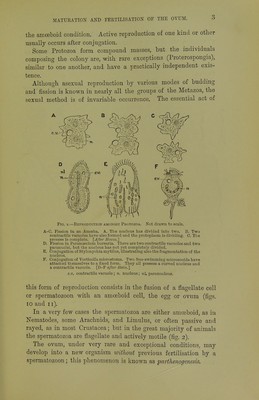
![the interior of the ovum ; eventually they disappear. The yolk of these ova appears to be largely derived from the follicular cells. The yolk consists of highly refractive particles, which vary considerably in their appearance and structure. As a rule, the yolk elements are small vesicles, which usually contain smaller vesicles and other bodies (fig. 28, b). In Birds the whole of the yolk at first consists of these white yolk spheres; but during the development of the egg, some of the white yolk spheres become modified to form the yellow yolk (fig. 28, A and c). In the ripe unincubated egg the yellow yolk constitutes the great mass of the yolk, the white yolk being restricted to a peripheral and several con- centric layers, and to a central mass which extends in a constricted neck, and again widens out to form a bed, upon which the blastoderm rests (fig. 28, A, w, y). It not unfrequently happens (many Hydrozoa, Insects, some Vertebrates, &c.) that certain of the primitive germ-cells feed upon neighbouring germ-cells, so that the growth of the ovum FS KE TS i Fig. 3.—SEcrioN through a Portiok of the Ovary of a Mammal. Illustrating the mode of development of the Graafian follicles. \From Wiedersheim. ] D. discus proligerus ; Ei. ripe ovum ; G. folli- cular cells of germinal epithelium ; g. blood- vessels ; K. germinal vesicle (nucleus) and ger- minal spot (nucleolus); KS. germinal epithelium; Lf. liquor foUiculi; Mg. membraua- or tunica- granulosa or follicular epithelium; 3Ip. zona pellucida ; PS. ingi-owths from the germinal epi- thelium, ovarian tubes, by means of which some of the nests retain their connection with the epi- thelium ; S. cavity which appears within the Graafian follicle ; So. stroma of ovary ; Tf. theca folliculi or capsule ; U. primitive ova. When an ovum with its surrounding cells has become sepa- rated from a nest, it is known as a Graafian fol- licle. and its store of food-yolk are made at the expense of its fellow germinal cells. In most Platyhelminths that portion of the primi- tive germinal epithelium which is destined to provide pabulum for the ova proper is separated from the ovary as yolk-glands, or mtellaria, and their products, yolk-cells or yolk-granules, surround the ova after they have lef c the ovary, and before they are enclosed within the egg-capsules. The yolk-cells may be regarded as ger- minal cells which have lost the power of reproduction, but retained that of forming yolk. Either the ovum or the embryo in due course feeds upon this reserve of food. When many ova are deposited within the same egg-capsule as in some forms of Prosobranch Gastropods (Buccinum), the more](https://iiif.wellcomecollection.org/image/b21443919_0040.jp2/full/800%2C/0/default.jpg)


 No text description is available for this image
 No text description is available for this image
 No text description is available for this image