An introduction to the study of embryology / by Alfred C. Haddon.
- Alfred Cort Haddon
- Date:
- 1887
Licence: Public Domain Mark
Credit: An introduction to the study of embryology / by Alfred C. Haddon. Source: Wellcome Collection.
Provider: This material has been provided by University of Bristol Library. The original may be consulted at University of Bristol Library.
41/374 page 7
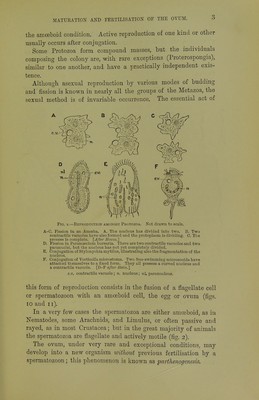
![1 iidvanced embryos devour those that are imperfectly developed, so that a very limited number, sometimes only a single individual, eventually escape from one capsule. The fusion of several germinal cells with one ovum does not correspond to the multiple conjugation of some Protozoa, as in the Fia. 4.—Diagrams of Ova [from various tources after Geddes}. Not drawn to scale. a. Diagram of a typical ovum with a delicate egg-membraue, granular proto- plasm, nucleus (gei-minal vesicle), and nucleolus (germinal spot). 6. Amoeboid ovum of Hydi-a [after Kleinenberg]. c. Early ovum of a Sea-Urchin (Toxopueustes variegatus) with pseudopodia-like processes extending into the gelatinous egg- membrane (vitelline membrane) in order to obtain nutriment from without; afterwards they become much finer and more regular, causing the vitelline membrane to have a striated appearauce ; hence it is termed the '•Zona radiata —the striae are really deUcate pores [after Selenka]. d. Nearly ripe ovum of Strongylocentrotus hvidus with its zona radiata [after Hertwig']. formation of plasmodia; it is merely the assimilation of several cells by one ovum, much as an Amoeba feeds upon its prey. An ovum is a small free cell which is characterised in the resting-stage by possessing a large clear nucleus, the germinal vesicle, and a well-marked highly refractive nucleolus, the ger- Fio. 5.—Ovum of the Gat. Highly magnified ; semi-diagrammatic. [Frovi Quain, after Schdfer.] gs. germinal spot; gv. germinal vesicle; vi. vitel- lus, or pi-otoplasm of ovum filled with yolk gran- nies, round which a dehcate membrane was seen ; zp. zona pellucida {Zona radiata); only a few radial pores are drawn. minal spot; in many cases several germinal spots occur. Eigs. 4 and 5 illustrate various kinds of ova. The protoplasm usually has, as has just been mentioned, the power of storing up albuminoid matter as reserve food material by a differentiation of its own substance in the form of yolk-granules or spheres. The amount of food-yolk varies greatly; in some few](https://iiif.wellcomecollection.org/image/b21443919_0041.jp2/full/800%2C/0/default.jpg)


 No text description is available for this image
 No text description is available for this image
 No text description is available for this image