An introduction to the study of embryology / by Alfred C. Haddon.
- Alfred Cort Haddon
- Date:
- 1887
Licence: Public Domain Mark
Credit: An introduction to the study of embryology / by Alfred C. Haddon. Source: Wellcome Collection.
Provider: This material has been provided by University of Bristol Library. The original may be consulted at University of Bristol Library.
46/374 page 12
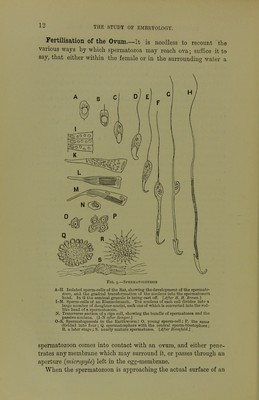
![Fertilisation of the Ovum.—It is needless to recount 'the various ways by which spermatozoa may reach ova; suffice it to say, that either within the female or in the surroundiufr water a Fig. 9.—Spermatogenesis A-H. Isolated sperm-ceUs of the Rat, showing the development of the spermato- zoon, and the gradual transformation of the nucleus into the spermatozoon head. In G the seminal granule is being cast off. [Jftei- H. H. Brown.] I-M. Sperm-cells of an Elasmobranch. The nucleus of each cell divides into a large number of daughter-nuclei, each one of which is converted into the rod- like head of a spermatozoon. N. Transverse section of a ripe cell, showing the bundle of spermatozoa and the passive nucleus. [I-N after Semper.] O-S. Spermatogenesis in the Earthworm: O. young sperm-cell; P. the same divided into four; Q. spermatosphere with the central sperm-blastophore ; R. a later stage; S. nearly mature spermatozoa. [After Blomfleld.] spermatozoon comes into contact with an ovum, and either pene- trates any membrane which may surround it, or passes through an aperture {micropyle) left in the egg-membrane. When the spermatozoon is approaching the actual surface of an](https://iiif.wellcomecollection.org/image/b21443919_0046.jp2/full/800%2C/0/default.jpg)




 No text description is available for this image
 No text description is available for this image
 No text description is available for this image