Report of the Reorganisation Commission for Milk.
- Great Britain. Agricultural Marketing Reorganisation Commission.
- Date:
- 1933
Licence: Public Domain Mark
Credit: Report of the Reorganisation Commission for Milk. Source: Wellcome Collection.
41/252 page 23
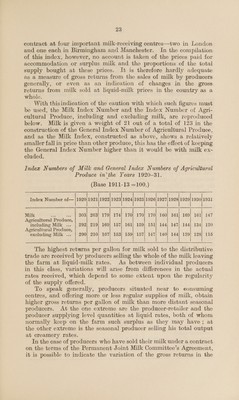
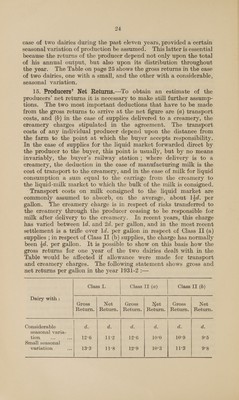
![contract at four important milk-receiving centres—two in London and one each in Birmingham and Manchester. In the compilation of this index, however, no account is taken of the prices paid for accommodation or surplus milk and the proportions of the total supply bought at these prices. It is therefore hardly adequate as a measure of gross returns from the sales of milk by producers generally, or even as an indication of changes in the gross returns from milk sold at liquid-milk prices in the country as a whole. With thisindication of the caution with which such figures must be used, the Milk Index Number and the Index Number of Agri- cultural Produce, including and excluding milk, are reproduced below. Milk is given a weight of 21 out of a total of 123 in the construction of the General Index Number of Agricultural Produce, and as the Milk Index, constructed as above, shows a relatively smaller fall in price than other produce, this has the effect of keeping the General Index Number higher than it would be with milk ex- cluded. 7 Index Numbers of Milk and General Index Numbers of Agricultural Produce in‘the Years 1920-31. (Base 1911-13 =100.) Index Number of— |1920)1921)1922) 1923) 1924) 1925/1926) 1927/1928/1929| 1930/1931 Milk <P .-- | 303) 263} 179) 174) 170] 170 a 160} 161) 169) 161) 147 Agricultural Produce, including Milk ... | 292} 219) 169} 157; 161} 159} 151) 144) 147| 144) 134} 120 Agricultural Produce, excluding Milk ... | 290) 210) 167) 153} 159} 157) 147; 140) 144) 139] 128) 115 The highest returns per gallon for milk sold to the distributive trade are received by producers selling the whole of the milk leaving the farm at liquid-milk rates. As between individual producers in this class, variations will arise from differences in the actual rates received, which depend to some extent upon the regularity of the supply offered. To speak generally, producers situated near to eonsuming centres, and offering more or less regular supplies of milk, obtain higher gross returns per gallon of milk than more distant seasonal producers. At the one extreme are the producer-retailer and the producer supplying level quantities at liquid rates, both of whom normally keep on the farm such surplus as they may have; at the other extreme is the seasonal producer selling his total output at creamery rates. In the case of producers who have sold their milk under a contraet on the terms of the Permanent Joint Milk Committee’s Agreement, it is possible to indicate the variation of the gross returns in the](https://iiif.wellcomecollection.org/image/b32177380_0041.jp2/full/800%2C/0/default.jpg)