Report of the Reorganisation Commission for Milk.
- Great Britain. Agricultural Marketing Reorganisation Commission.
- Date:
- 1933
Licence: Public Domain Mark
Credit: Report of the Reorganisation Commission for Milk. Source: Wellcome Collection.
57/252 page 39
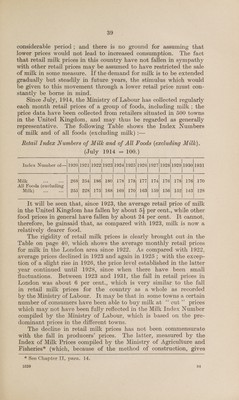
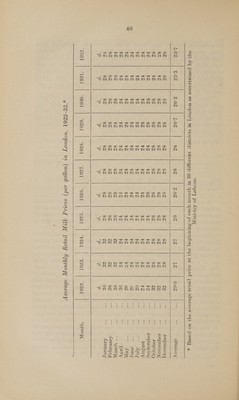
![considerable period ; and there is no ground for assuming that lower prices would not lead to increased consumption. The fact that retail milk prices in this country have not fallen in sympathy with other retail prices may be assumed to have restricted the sale of milk in some measure. If the demand for milk is to be extended - gradually but steadily in future years, the stimulus which would be given to this movement through a lower retail price must con- stantly be borne in mind. Since July, 1914, the Ministry of Labour has collected regularly each month retail prices of a group of foods, including milk ; the price data have been collected from retailers situated in 500 towns in the United Kingdom, and may thus be regarded as generally representative. The following Table shows the Index Numbers of milk and of all foods (excluding milk) :— Retail Index Numbers of Milk and of All Foods (excluding Milk). (July 1914 = 100.) i Index Number of— ne os 1922 1991904925 1926) 1927) 1928] 1929) 1930)1931 = Milk nae .-» | 268) 254) 186) 180, 178) 178) 177| 174) 176]} 178) 176) 170 All Foods (excluding Milk) 5 aa se 228) 175| 168 os 170} 163) 159 a 152} 143) 128 It will be seen that, since 1923, the average retail price of milk in the United Kingdom has fallen by about 54 per cent., while other food prices in general have fallen by about 24 per cent. It cannot, therefore, be gainsaid that, as compared with 1923, milk is now a relatively dearer food. The rigidity of retail milk prices is clearly brought out in the Table on page 40, which shows the average monthly retail prices for milk in the London area since 1922. As compared with 1922, average prices declined in 1923 and again in 1925 ; with the excep- tion of a slight rise in 1926, the price level established in the latter year continued until 1928, since when there have been small fluctuations. Between 1923 and 1931, the fall in retail prices in London was about 6 per cent., which is very similar to the fall in retail milk prices for the country as a whole as recorded by the Ministry of Labour. It may be that in some towns a certain number of consumers have been able to buy milk at “ cut” prices which may not have been fully reflected in the Milk Index Number compiled by the Ministry of Labour, which is based on the pre- dominant prices in the different towns. — The decline in retail milk prices has not been commensurate with the fall in producers’ prices. The latter, measured by the Index of Milk Prices compiled by the Ministry of Agriculture and Fisheries* (which, because of the method of construction, gives * See Chapter IT, para. 14.](https://iiif.wellcomecollection.org/image/b32177380_0057.jp2/full/800%2C/0/default.jpg)