Report of the Reorganisation Commission for Milk.
- Great Britain. Agricultural Marketing Reorganisation Commission.
- Date:
- 1933
Licence: Public Domain Mark
Credit: Report of the Reorganisation Commission for Milk. Source: Wellcome Collection.
71/252 page 53
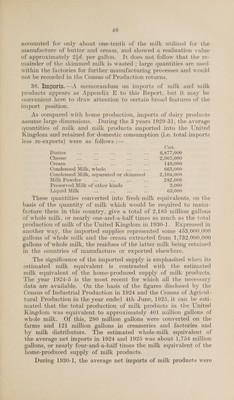
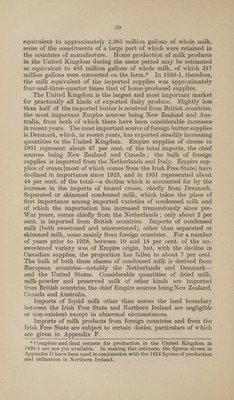
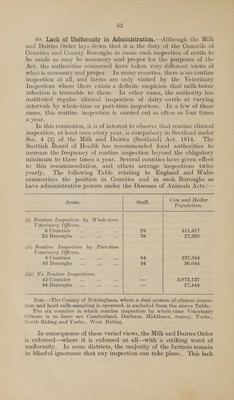
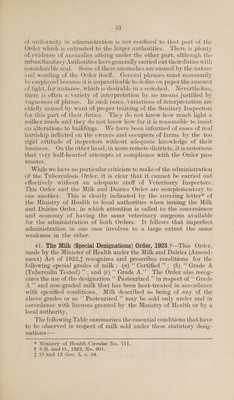
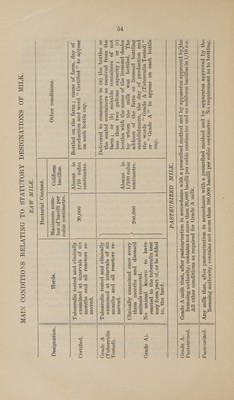
![of uniformity in administration is not confined to that part of the Order which is entrusted to the larger authorities. There is plenty of evidence of anomalies arising under the other part, although the urban Sanitary Authorities have generally carried out their duties with considerable zeal. Some of these anomalies are caused by the nature and wording of the Order itself. General phrases must necessarily be employed because it is impracticable to define on paper the amount of light, for instance, which is desirable in a cowshed. Nevertheless, there is often a variety of interpretation by no means justified by vagueness of phrase. In such cases, variations of interpretation are chiefly caused by want of proper training of the Sanitary Inspectors for this part of their duties. They do not know how much light a milker needs and they do not: know how far it is reasonable to insist on alterations to buildings. We have been informed of cases of real hardship inflicted on the owners and occupiers of farms by the too rigid attitude of inspectors without adequate knowledge of their business. On the other hand, in more remote districts, it is notorious that very half-hearted attempts at compliance with the Order pass muster. While we have no particular criticism to make of the administration of the Tuberculosis Order, it is clear that it cannot be carried out effectively without an adequate staff of Veterinary Inspectors. This Order and the Milk and Dairies Order are complementary to one another. This is clearly indicated by the covering letter* of the Ministry of Health to local authorities when issuing the Milk and Dairies Order, in which attention is called to the convenience and economy of having the same veterinary surgeons available for the administration of both Orders. It follows that imperfect administration in one case involves to a large extent the same weakness in the other. 41. The Milk (Special Designations) Order, 1928.;—This Order, made by the Minister of Health under the Milk and Dairies (Amend- ment) Act of 1922,t recognizes and prescribes conditions for the following specia] grades of milk: (a) “ Certified’; (6) ‘“ Grade A (Tuberculin Tested) ” ; and (c) “‘ Grade A.”’ The Order also recog- nizes the use of the designation “* Pasteurized ”’ in respect of “ Grade A” and non-graded milk that has been heat-treated in accordance with specified conditions. Milk described as being of any of the above grades or as “ Pasteurized ”’ may be sold only under and in accordance with licences granted by the Ministry of Health or by a local authority. The following Table summarizes the essential conditions that have to be observed in respect of milk sold under these statutory desig- nations :— * Ministry of Health Circular No. 711. + S.R. and O., 1923, No. 601. £ 12 and 13 Geo. 5, ce, 54.](https://iiif.wellcomecollection.org/image/b32177380_0071.jp2/full/800%2C/0/default.jpg)