Phrenology proved, illustrated, and applied : accompanied by a chart : embracing an analysis of the primary, mental powers in their various degrees of development, the phenomena produced by their combined activity and the location of the phrenological organs in the head : together with a view of the moral and theological bearing of the science / by O.S. & L.N. Fowler ; assisted by Samuel Kirkham.
- Orson S. Fowler
- Date:
- 1837
Licence: Public Domain Mark
Credit: Phrenology proved, illustrated, and applied : accompanied by a chart : embracing an analysis of the primary, mental powers in their various degrees of development, the phenomena produced by their combined activity and the location of the phrenological organs in the head : together with a view of the moral and theological bearing of the science / by O.S. & L.N. Fowler ; assisted by Samuel Kirkham. Source: Wellcome Collection.
Provider: This material has been provided by the National Library of Medicine (U.S.), through the Medical Heritage Library. The original may be consulted at the National Library of Medicine (U.S.)
14/426
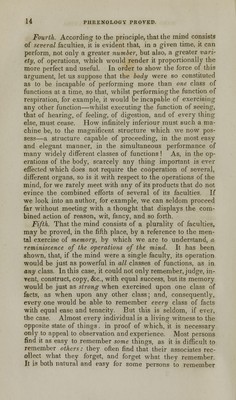
![PHRENOLOGY PROVED. pie, as the amputation of a limb, produces no such effect How can these things be accounted for on any other princi- ple than that which recognises the brain as the organ of the mind? Sixth. There is found to exist a reciprocal proportion be- tween the power and qualities of the mind, and the size, activity, and shape of the brain. An observation of the va- rious classes of animals, will illustrate this position. The worm has little or no brain, and (except sensation) little or no intellect or passion. The frog, the toad, the turtle, &c. have a contracted and flattened brain, and the mental powers proportionally weak. The dog, the monkey, the elephant, &c., possess a cerebral development far superiour to those animals last-named, and an intellect equally superiour. Idi- ots are found to possess brains vastly inferiour to those be- longing to men of ordinary talents; and these, again, a development of this organ far inferiour to that of a Frank- lin, a Bacon, a De Witt Clinton, a Webster, a Bonaparte, a Sir Walter Scott, &c.: in other words, as we rise in the scale of animated being from the lowest grade tothe highest, at every ascending step, we invariably find, particularly in the coronal and frontal regions of 'the head, (in which, according to phrenology, the intellectual and moral organs are located,) an additional amount of brain. Are these things merely the result of chance; or do they show de- sign ?—are they merely accidental; or are they the result of fixed and immutable laws? Other arguments in favour of the proposition that the brain is the organ of the mind, might easily be adduced; but, since it is generally admitted by the great naturalists, anatomists, physiologists, metaphysicians, and philosophers, it might fairly be assumed, and the burden of proof thrown upon those who call it in question. II. The mind consists of a -plurality of innate and inde- pendent faculties—a congregate of separate, primary pow- ers. The truth of this proposition may be shown by the following arguments. First. The mind performs different classes of functions, or various kinds of operations, such as love, hatred, fear] reason, sensation, &c. ; and, throughout all nature, different classes of functions are always performed by different in- struments. It is admitted, that seeing and hearing are men- tal operations, and, also, that they are performed by different](https://iiif.wellcomecollection.org/image/b21120432_0014.jp2/full/800%2C/0/default.jpg)