Volume 1
Long-range program and research needs in aging and related fields : hearings before the Special Committee on Aging, United States Senate, Ninetieth Congress, first session Washington, D.C. December 5 and 6, 1967.
- United States Senate Special Committee on Aging
- Date:
- 1968-
Licence: Public Domain Mark
Credit: Long-range program and research needs in aging and related fields : hearings before the Special Committee on Aging, United States Senate, Ninetieth Congress, first session Washington, D.C. December 5 and 6, 1967. Source: Wellcome Collection.
411/500 (page 401)
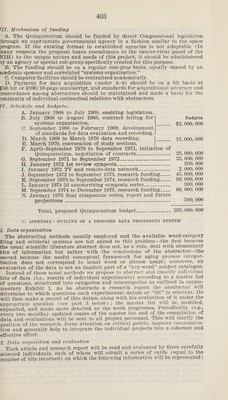
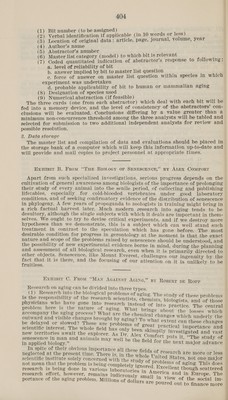
![401] problem will probably mimic the enormous material and human benefits that have resulted from the basic understanding of natural laws in other areas of science. (3) The fact that the past decade has seen a remarkable growth of our understanding of many fundamental biological phenomena, particularly in the field of genetics. These and related technological advances appear to be ripe for exploration in complex multidisciplinary problem areas, such as gerontology. II. Present status of field An understanding of the biological origins of the aging process is hampered by three related lacks: (1) Deficient organization and availability of the basic in- formation already available; (2) Insufficient involvement of adequate numbers of informed and highly competent bio-medical scientists in research on this complex problem; and (3) Absence of administrative initiative, coordinative planning, and funding of research support. In this respect scientific administrators have behaved in a manner not too different from that which is accepted practice in non- entrepreneurial commercial enterprise: i.e., it is more secure both personally and institutionally to invest in and support administratively those programs which represent little risk and which correspond to the immediate goals of the granting agency and laboratory scientist. These triple lacks reinforee each other. Thus, the involvement of adequate num- bers of outstanding basic scientists is dependent upon the availability of admin- istrative and financial support and of a succinct and orderly access to the data already available; the accumulation of such data is in direct proportion to the in- cisiveness of the experimental questions posed and to the ready availability of relevant research resources in a hospitable environment. The proposed International Gerontological Quinquennium is designed to over- come each of these lacks through an orderly and systematic approach to the prob- lem—an approach which, though highly successful in the attack on physical- science technological problem areas, has not yet become part of research plan- ning in most areas of biomedical research. (The proposal represents a synthesis of several plans for a more intensive attack on the problem, parts of which plan were developed independently by two English colleagues, Dr. Daphne Osborne and Dr. Alex Comfort, and by Dr. William Forbes of the University of Rochester. While none of these outstanding persons should take responsibility for the exact form of this proposal, I wish to acknowledge my indebtedness to them for many central concepts. I should also like to acknowledge many helpful discussions with and suggestions regarding “Systems” aspects from Doctors S. Kaplan, G. Reese, W. Larson, J. Birren and R. Bellman. ) Relation of Present Proposal to Prior Systematic Undertakings: The elements of the present proposal, [(a) critical evaluation, storage, organization and re- trieval of data, (b) evaluation and projection of short- and long-range objectives, and (c) funding and implementation of critical tests of hypotheses implicit in (a) and (b) above] are presumably applicable to any complex problem. However, the biological nature of the aging process, as a discrete, though complex, part of biomedical science, is particularly suited to the rigors of “systems analysis” for the following reasons: (1) the sources of the fundamental bits of informa- tion are exceedingly diverse, (2) the interactions of component failures in bio- logical systems are highly complex, and (3) the validity of conclusions presented in the literature is quite variable and not immediately apparent. This complex of factors introduces an inherent uncertainty into this complex informational matrix which the individual scientist must use as a base for his experimental projections. Nevertheless, it should be emphasized that the problem of biological aging is particularly susceptible to an organized inquiry both because the basic potential sources of failure can be rigorously defined, and because relevant data are limited to about twenty such basic categories into which experimental findings can be classified and coded. Although many of the more important basic questions raised by this Systems- failure categorization have received little or no attention, they are, in fact, so closely related to other basic fields of inquiry that the expansion of research in these other areas so as to include additional appropriate questions and parameters ean provide a large portion of the information needed to fill the bio-aging informa- tional matrix. In particular, much of current molecular-developmental biology research will contribute information of potential relevance to the aging process. The evolution of the systems approach and computer hardware has progressed](https://iiif.wellcomecollection.org/image/b32178128_0001_0411.jp2/full/800%2C/0/default.jpg)