Volume 1
Long-range program and research needs in aging and related fields : hearings before the Special Committee on Aging, United States Senate, Ninetieth Congress, first session Washington, D.C. December 5 and 6, 1967.
- United States Senate Special Committee on Aging
- Date:
- 1968-
Licence: Public Domain Mark
Credit: Long-range program and research needs in aging and related fields : hearings before the Special Committee on Aging, United States Senate, Ninetieth Congress, first session Washington, D.C. December 5 and 6, 1967. Source: Wellcome Collection.
424/500 (page 414)
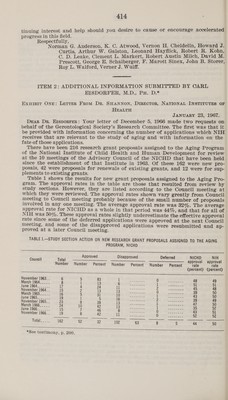
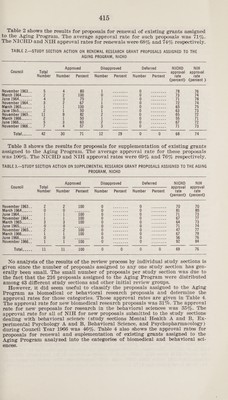
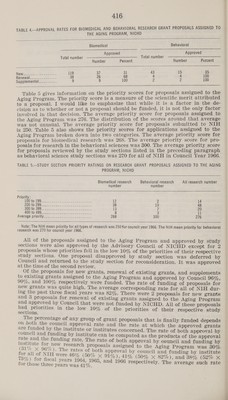
![tinuing interest and help should you desire to cause or encourage accelerated progress in this field. Respectfully, Noruae G. Anderson, K. C. Atwood, Vernon H. Cheldelin, Howard J. Curtis, Arthur W. Galston, Leonard Hayflick, Robert R. Kohn, C. D. Leake, Clement L. Markert, Robert Austin Milch, David M. Prescott, George E. Schaiberger, F. Marott Sinex, John B. Storer, Roy L. Walford, Verner J. Wulff. ITEM 2: ADDITIONAL INFORMATION SUBMITTED BY CARL EISDORFER, M.D., Pu. D.* EXHIBIT ONE: LETTER FROM DR. SHANNON, DIRECTOR, NATIONAL INSTITUTES OF HEALTH JANUARY 23, 1967. Deak Dr. ExsporFer: Your letter of December 5, 1966 made two requests on behalf of the Gerontological Society’s Research Committee. The first was that it be provided with information concerning the number of applications which NIH receives that are relevant to the study of aging and with information on the fate of those applications. There have been 216 research grant proposals assigned to the Aging Program of the National Institute of Child Health and Human Development for review at the 10 meetings of the Advisory Council of the NICHD that have been held . since the establishment of that Institute in 1963. Of these 162 were new pro- posals, 42 were proposals for renewals of existing grants, and 12 were for sup- plements to existing grants. Table 1 shows the results for new grant proposals assigned to the Aging Pro- gram. The approval rates in the table are those that resulted from review by study sections. However, they are listed according to the Council meeting at which they were reviewed. The approval rates shown vary greatly from Council meeting to Council meeting probably because of the small number of proposals involved in any one meeting. The average approval rate was 32%. The average approval rate for NICHD as a whole in that period was 44%, and that for all of NIH was 50%. These approval rates slightly underestimate the effective approval rate since some of the deferred applications were approved at the next Council meeting, and some of the disapproved applications were resubmitted and ap- proved at a later Council meeting. TABLE 1.—STUDY SECTION ACTION ON NEW RESEARCH GRANT PROPOSALS ASSIGNED TO THE AGING PROGRAM, NICHD ere eee tc i ee ce, Bee ce ee ‘ Approved Disapproved Deferred NICHD NIH Council Total § ————_—— se approval approval Number Number Percent Number Percent Number Percent rate rate (percent) (percent) November 1963__ 6 5 83 1 -March 1964_____ 8 1 13 6 rf Wide : iat 2 5 st June 1964.._____ 17 4 24 a eae? re 45 48 November 1964__ 15 2 13 i: ones AE Qe ee 39 50 March 1965._____ 16 5 31 10 3 fh Gib qo SERIE 43 50 June 1965.______ 1 5 igiouy: SaTdinat, Se: ates 39 49 November 1965. _ 23 9 39 f eaieap ape sag i Palast: ig 47 50 arch 1966_____ 4 10 42 13 niin apne 35 52 June 1966....___ 7 46 8 ieee OT AP es 43 51 November 1966... 19 8 42 11 Lick ee Gy an fee Hs 52 52 _—————— ——_— —ae eee || See, —— Ss + ° Sal = i ' ' ' i > RO on N w Lee) — =] Dh for) Ww co on > = uo o *See testimony, p. 200.](https://iiif.wellcomecollection.org/image/b32178128_0001_0424.jp2/full/800%2C/0/default.jpg)