The constituents of commercial chrysarobin / by Frank Tutin and Hubert W.B. Clewer.
- Tutin, Frank.
- Date:
- [1912?]
Licence: In copyright
Credit: The constituents of commercial chrysarobin / by Frank Tutin and Hubert W.B. Clewer. Source: Wellcome Collection.
6/20 page 293
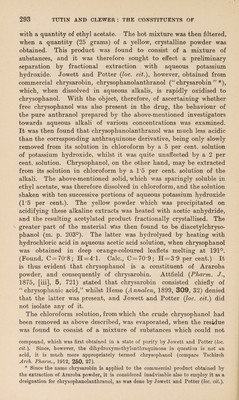
![with a quantity of ethyl acetate. The hot mixture was then filtered, when a quantity (25 grams) of a yellow, crystalline powder was obtained. This product was found to consist of a mixture of substances, and it was therefore sought to effect a preliminary separation by fractional extraction with aqueous potassium hydroxide. Jowett and Potter (loc. cit.), however, obtained from commercial chrysarobin, chrysophanolanthranol (“ chrysarobin ” *), which, when dissolved in aqueous alkalis, is rapidly oxidised to chrysophanol. With the object, therefore, of ascertaining whether free chrysophanol was also present in the drug, the behaviour of the pure anthranol prepared by the above-mentioned investigators towards aqueous alkali of various concentrations was examined. It was then found that chrysophanolanthranol was much less acidic than the corresponding anthraquinone derivative, being only slowly removed from its solution in chloroform by a 5 per cent, solution of potassium hydroxide, whilst it was quite unaffected by a 2 per cent, solution. Chrysophanol, on the other hand, may be extracted from its solution in chloroform by a 1'5 per cent, solution of the alkali. The above-mentioned solid, which was sparingly soluble in ethyl acetate, was therefore dissolved in chloroform, and the solution shaken with ten successive portions of aqueous potassium hydroxide (1‘5 per cent.). The yellow powder which was precipitated on acidifying these alkaline extracts was heated with acetic anhydride, and the resulting acetylated product fractionally crystallised. The greater part of the material Was then found to be diacetylchryso- phanol (m. p. 203°). The latter was hydrolysed by heating with hydrochloric acid in aqueous acetic acid solution, when chrysophanol was obtained in deep orange-coloured leaflets melting at 191°. (Found, C = 70'8; H = 4T. Calc., C = 70'9; H==3‘9 per cent.) It is thus evident that chrysophanol is a constituent of Araroba powder, and consequently of chrysarobin. Attfield (Pharm. J., 1875, [iii], 5, 721) stated that chrysarobin consisted chiefly of “ chrysophanic acid,” whilst Hesse (Annalen, 1899, 309, 32) denied that the latter was present, and Jowett and Potter (loc. cit.) did not isolate any of it. The chloroform solution, from which the crude chrysophanol had been removed as above described, was evaporated, when the residue was found to consist of a mixture of substances which could not compound, which was first obtained in a state of purity by Jowett and Potter (loc. cit.). Since, however, the dihydroxymethylanthraquinone in question is not an acid, it is much more appropriately termed chrysophanol (compare Tschirch Arch. Pharm., 1912, 250, 27). * Since the name chrysarobin is applied to the commercial product obtained by the extraction of Araroba powder, it is considered inadvisable also to employ it as a designation for chrysophanolanthranol, as was done by Jowett and Potter (loc. cit.).](https://iiif.wellcomecollection.org/image/b30619580_0006.jp2/full/800%2C/0/default.jpg)