The microscope and its revelations / by William B. Carpenter.
- William Benjamin Carpenter
- Date:
- 1901
Licence: Public Domain Mark
Credit: The microscope and its revelations / by William B. Carpenter. Source: Wellcome Collection.
Provider: This material has been provided by the Francis A. Countway Library of Medicine, through the Medical Heritage Library. The original may be consulted at the Francis A. Countway Library of Medicine, Harvard Medical School.
35/1270 (page 7)
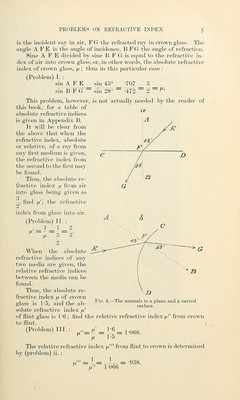
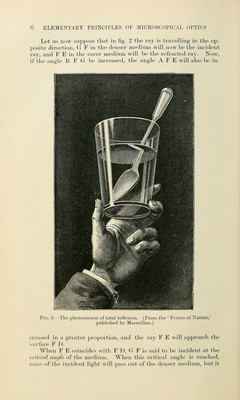
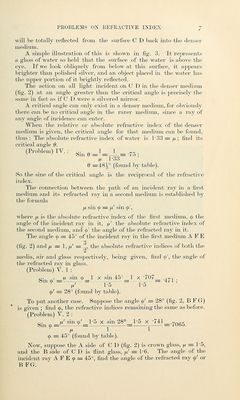
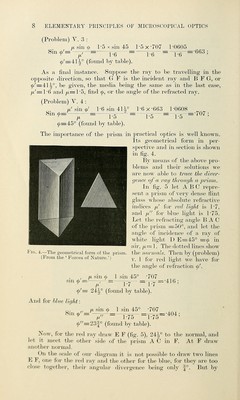
![will be totally reflected from the surface C D back into the denser medium. A simple illustration of this is shown in fig. 3. It represents a glass of water so held that the surface of the water is above the eye. If we look obliquely from below at this surface, it appears brighter than polished silver, and an object placed in the water has the upper portion of it brightly reflected. The action on all light incident on C D in the denser medium (fig. 2) at an angle greater than the critical angle is precisely the same in fact as if C D were a silvered mirror. A critical angle can only exist in a denser medium, for obviously there can be no critical angle in the rarer medium, since a ray of any angle of incidence can enter. Wlien the relative or absolute refractive index of the den8er medium is given, the critical angle for that medium can be found, thus: The absolute refractive index of water is l'33 = /i; find its critical angle 9. (Problem) IV. : .<■ ^ 1 1 ^r // l'3o ' B =481° (found by table). So the sine of the critical angle is the reciprocal of the refractive index. The connection between the path of an incident ray in a first medium and its refracted ray in a second medium is established by the formula jx sin (f> ^ fi' sin (f>', where jj. is the absolute refractive index of the first medium, 0 the angle of the incident ray in it, /j' the absolute refractive index of the second medium, ancl (// the angle of the refracted ray in it. The angle (j> = 45° of the incident ray in the first medium A F E (fig. 2) and jj. = 1, ^^ = ^, the absolute refractive indices of both the A media, air and glass respectively, being given, find f', the angle of the refracted ray in glass. (Problem) Y. 1 : o- , /u sin 0_1 X sin45°_l x '707 .^-. m 0 - -^ ^-^- 0' = 28° (found by table). To put another case. Suppose the angle 0' = 28° (fig. 2, B F G) is given ; find 0, the refractive indices remaining the same as before. (Problem) Y. 2 : Sin 0 ^/Bin 0-^1-5 X sin28°^]_-5 x -T^l^.^Qg^ fX 1 1 0 = 45° (found by table). Now, suppose the A side of C D (fig. 2) is crown glass, ju = 1-5, and the B side of C D is flint glass, / = 1-6. The angle of the incident ray A F E 0 = 45, find the angle of the refracted ray 0' or BFG.](https://iiif.wellcomecollection.org/image/b21175809_0035.jp2/full/800%2C/0/default.jpg)