The microscope and its revelations / by William B. Carpenter.
- William Benjamin Carpenter
- Date:
- 1901
Licence: Public Domain Mark
Credit: The microscope and its revelations / by William B. Carpenter. Source: Wellcome Collection.
Provider: This material has been provided by the Francis A. Countway Library of Medicine, through the Medical Heritage Library. The original may be consulted at the Francis A. Countway Library of Medicine, Harvard Medical School.
36/1270 (page 8)
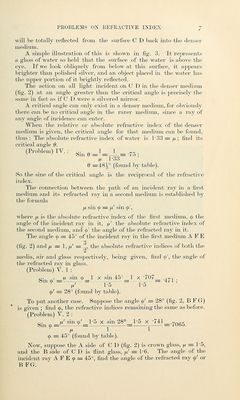
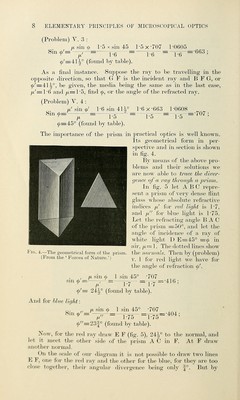
![(Problem) V. 3 : jx sin (^ 1-5 X sin 45 1-5 x 707 1-0605 ^^^¥='^^= Te = r6~ = ~r6 = ^^^' <p'=i\\° (found by table). As a final instance. Suppose the ray to be travelling in the opposite direction, so that G F is the incident ray and B F G, or ^'':=41^°, be given, the media being the same as in the last case, yu,'=l6 and ju,= l5, find ^, or the angle of the refracted ray. (Problem) V. 4: / sin (p' 1-6 sin 4H° 1-6 x-663 1-0608 ^^^ ^=^-;r~=--TF-^ = ^hF-=T5-=-^07 ; ^=45° (found by table). The importance of the prism in practical optics is well known. Its geometrical form in per- spective and in section is shown in fig. 4. By means of the above pro- blems and their solutions we are now able to trace the diver- gence of a ray through a pristn. In fig. 5 let ABC repre- sent a, prism of very dense fiint glass whose absolute refi-active indices /x' for reel light is I'T, and It!' for blue light is 1-75. Let the refracting angle BAG of the prism =50°, and let the angle of incidence of a ray of white light D E=45° =9. in air, //,= 1. The dotted lines show Fig. 4.—The geometrical form of the prism, the normals. Then by (problem) (From the'Forces of Nature.') y_ j fo^. ^.^^ jig.]^^ ^g ^^^^^ fo^. the angle of refraction (j)'. , //, sin (h 1 sin 45° -707 ,3n ^'^--,-^=.-^^ =-p7=-416 ; 0'= 24^° (found by table). And for hlue light IX sin 0 1 sin 45° -707 «in /'='-;; ^=^5- =r75='^o^' 0''=23|° (foTuid l)y table). Now, for the red ray draw E F (fig. 5), 24^° to the normal, and let it meet the other side of the jn-ism A G in F. At F draw another noi-mMl. On the scale of our diiigr;iiii it is not possible, to draw two lin(!s E F, one foi- the red ray and the other for the blue, for they are too close together, their angular divergence being only |°. But by](https://iiif.wellcomecollection.org/image/b21175809_0036.jp2/full/800%2C/0/default.jpg)