The microscope and its revelations / by William B. Carpenter.
- William Benjamin Carpenter
- Date:
- 1901
Licence: Public Domain Mark
Credit: The microscope and its revelations / by William B. Carpenter. Source: Wellcome Collection.
Provider: This material has been provided by the Francis A. Countway Library of Medicine, through the Medical Heritage Library. The original may be consulted at the Francis A. Countway Library of Medicine, Harvard Medical School.
50/1270 (page 22)
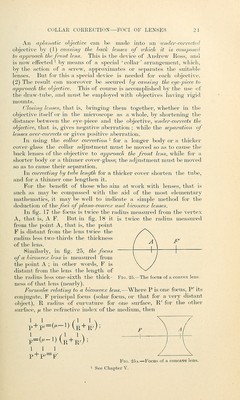
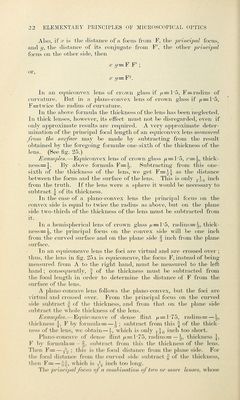
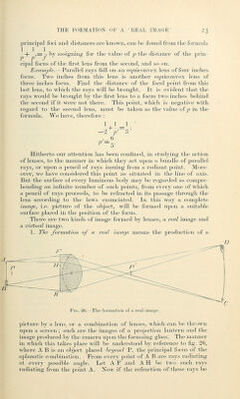
![Also, if X is the distance of a focus from F, the jt>?'mci^/)aZ focus, and y, the distance of its conjugate from F', the other princi2)al fo_cus on the other side, then or, X ?/=F F' xy=Y'\ In an eqviiconvex lens of crown glass if /j = 15, F=radius of curvature. But in a plano-convex lens of crown glass if yu = l5, F=twice the radius of curvature. In the above formula the thickness of the lens has been neglected. In thick lenses, however, its effect must not be disregarded, even if only approximate results are i-equired. A very approximate deter- mination of the principal focal length of an equiconvex lens ^measured from the surface may be made by subtracting from the result obtained by the foregoing formula? one-sixth of the thickness of the lens. (See fig. 25.) Exaraj)les.—Equiconvex lens of crown glass ju = l5, r:=.\, thick- ness=j. By above formula F=^. Subtracting from this one- sixth of the thickness of the lens, we get F=^ as the distance between the focus and the surface of the lens. This is only 2^5^ inch from the truth. If the lens were a sphere it would be necessary to subtract \ of its thickness. In the case of a plano-convex lens the principal focus on the convex side is equal to twice the radius as above, but on the plane side two-thirds of the thickness of the lens must be subtracted from it. In a hemispherical lens of crown glass ^ = 1'5, i'adius=^, thick- ness=^, the principal focus on the convex side will be one inch from the curved surface and on the plane side ^ inch from the plane surface. In an equiconcave lens the foci are virtual and are crossed over ; thus, the lens in fig. 25a is equiconcave, the focus F, instead of being- measured, from A to the right hand, must be measured to the left hand; consequently, \ of the thickness must be subtracted from the focal length in order to determine the distance of F from the surface of the lens. A plano-concave lens follows the plano-convex, but the foci are virtual and ci-ossed over. Fi'om the principal focus on the cui-ved side subtract |- of the thickness, and from that on the plane side subtract the whole tliickness of the lens. Examples.—Equiconcave of dense flint /x = l75, ra.dius = — \, thickness \, F by formula = — i ; subtract fi'ona this \ of the thick- ness of the lens, we obtain—\, which is only jjj, inch too short. Plano-concave of dense flint/^ = 1 75, raditis=— !,-, thickness], F by formula= - §, subtract from this the thickness of the lens. Tlien F=—^\-; this is the focal distance from the plane side. Foi- the focal distance fi-om tlie cm-ved side subtract j| of the thickness, then F= — f;;':, which is -^ incli too long. The pi'incipalfoc'i's of a coiahriiatioii, of ivo or 'more lenses, wliose](https://iiif.wellcomecollection.org/image/b21175809_0050.jp2/full/800%2C/0/default.jpg)