The microscope and its revelations / by William B. Carpenter.
- William Benjamin Carpenter
- Date:
- 1901
Licence: Public Domain Mark
Credit: The microscope and its revelations / by William B. Carpenter. Source: Wellcome Collection.
Provider: This material has been provided by the Francis A. Countway Library of Medicine, through the Medical Heritage Library. The original may be consulted at the Francis A. Countway Library of Medicine, Harvard Medical School.
54/1270 (page 26)
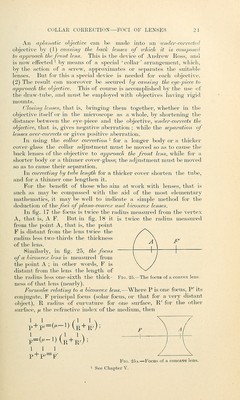
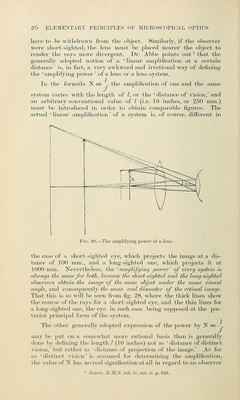
![have to be withdrawn from the object. Similarly, if the observer were short-sighted, the lens must be placed nearer the object to render the rays more divergent. Dr. Abbe points out ^ that the generally adopted notion of a ' linear amplification at a certain distance' is, in fact, a very awkward and irrational way of defining the ' amplifying power' of a lens or a lens-system. In the formula N = -- the amplification of one and the same system varies with the length of Z, or the ' distance of visioai,' and an arbitrary conventional value of I (i.e. 10 inches, or 250 mm.) must be introduced in order to obtain comparable figures. The actual ' linear amplification' of a system is, of course, different in Fig. 28.—The amplifying power of a lens. the case of a short-sighted eye, which projects the image at a dis- tance of 100 mm., and a long-sighted one, which projects it at 1000 mm. ISTevertheless, the '■ aimplifying power ^ of every system is always the same for hoth^ because the short-sighted and the long-sighted, observers obtain the image of the same object under the same vis^tal angle, and consequently ttte same real diameter of the retinal image. That this is so will be seen from fig. 28, where the thick lines show the course of the rays for a short-sighted eye, and the thin lines for a long-sighted one, the eye in each case being su})posed at the pos- terior pi-incipal focus of the system. Tlie other generally ;id()]»ted ex})ression of the power by N = I f may be |iut <iii ;i somewhat more raticmal bji-sis than is generally done Vjy dcjiniiig the lengtli I (10 inches) not as ' distance of distinct vision,' but i-athei- as ' di.stance of ja-ojection of tlie image.' As far as 'distinct visifni' is assumed for determining tlu^ ;nii])lific;ition, the valueof X ii;is no real signification at all in i-egard ionii ()l)servei' ' Joiirii. U.M.H. vol. iv. Her. ii. p. 348.](https://iiif.wellcomecollection.org/image/b21175809_0054.jp2/full/800%2C/0/default.jpg)