A treatise on Bright's disease and diabetes with especial reference to pathology and therapeutics / by James Tyson ; including a section on retinitis in Bright's disease by William F. Norris.
- Date:
- 1881
Licence: Public Domain Mark
Credit: A treatise on Bright's disease and diabetes with especial reference to pathology and therapeutics / by James Tyson ; including a section on retinitis in Bright's disease by William F. Norris. Source: Wellcome Collection.
Provider: This material has been provided by the Royal College of Physicians of Edinburgh. The original may be consulted at the Royal College of Physicians of Edinburgh.
44/338 page 40
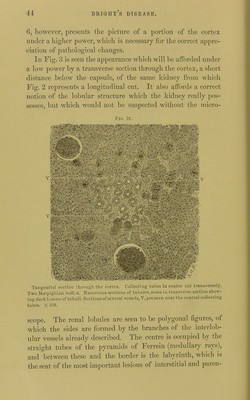
![It is even claimed by Axel Key that a reticular connective tissue formed of stellate cells is found uniting the capillar] and capillary lobules of which the glomerule is composed. The Capsule of the Kidney.—The kidney is surrounded by a firm capsule, composed mostly of fibrillar connective tissue imperfectly laminated. In health it is very loosely ad- herent by a looser and more delicate layer, to the cortex of the organ, whence it is therefore stripped with facility, the only attachments being a few filaments of connective tissue, and some small bloodvessels which pass from one to the other. In certain diseased states, especially where the connective tissue is involved, this adhesion is more intimate, so that it is impos- sible to strip off the capsule without dragging more or less of the secreting structure of the kidney with it; and in descrip- tions of post-mortem conditions, we constantly read that the capsule stripped off easily or was closely adherent, etc. Eberth describes a plexus of unstriped muscular fibre-cells under the capsule of the kidney in man. The blood-supply of the capsule is derived partly from those branches of the interlobular arteries which do not proceed as afferent vessels to the Malpighiau bodies, and partly from branches of the phrenic, lumbar, and supra-renal arteries. These form a large-meshed capillary system, whence the blood is collected by corresponding veins, including the stellate veins of the cortex. IV. The Lymphatic Vessels of the Kidney. The extended information recently acquired with regard to the lymphatic system in general, only partially includes that of the kidneys, although the researches of Ludwig and Zawarykin* have furnished some facts of importance. From them we learn : 1st, that the capsule of the kidney is provided with well- defined lymphatics possessing even valves; 2d, that similar larger trunks issue from the hilus of the organ along with the artery and vein ; and, 3d, that the spaces between the tubules * C. Ludwig mit Zawarykin, Wiener Akademische Sitzungberichte, Bel. xlviii.](https://iiif.wellcomecollection.org/image/b21986927_0044.jp2/full/800%2C/0/default.jpg)