The temperance problem and social reform / by Joseph Rowntree and Arthur Sherwell.
- Joseph Rowntree
- Date:
- 1900
Licence: Public Domain Mark
Credit: The temperance problem and social reform / by Joseph Rowntree and Arthur Sherwell. Source: Wellcome Collection.
60/882 page 24
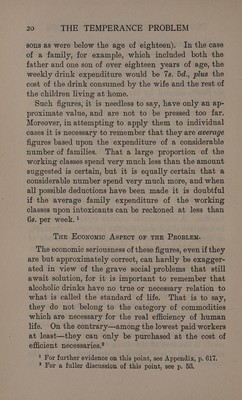
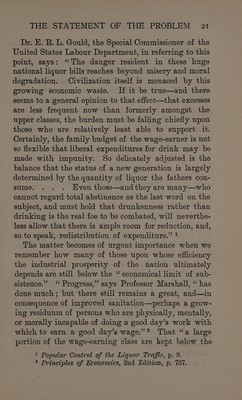
![(the “very poor’’), and 2,400 to classes C and D! (the “poor ”). Of the former (i.e., the cases of the “ very poor”’) :— 4 per cent. were “loafers.” 14 ‘per cent. were attributable to drink and thrift- lessness. 27 per cent. were attributable to “ questions of circumstance ” (é.e., large families, illness, etc.). 55 per cent. were attributable to ‘“ questions of employment.” Of the ladter (i.e., the cases of the “ poor”’) :— 13 per cent. were attributable to drink and thrift- lessness. 19 per cent. were attributable to “questions of circumstance.” 68 per cent. were attributable to ‘questions of employment.” In his comment upon the figures, Mr. Booth says: ‘To those who look upon drink as the source of all evil, the position it here holds as accounting for only 14 per cent. of the poverty in the East End may seem altogether insufficient ; but I may remind them that it is only as principal cause that it is here con- sidered; as contributory cause it would no doubt be Together the ‘ poor,” ze. those 1 Class “C”— who live “ under a struggle to Intermittent earnings obtain the necessaries of life and make both ends meet,” Class *D”— whose family earnings vary Smal]l regular earnings from 18s. to 21s. per week for a family of moderate size.](https://iiif.wellcomecollection.org/image/b32740268_0060.jp2/full/800%2C/0/default.jpg)



 No text description is available for this image
 No text description is available for this image
 No text description is available for this image