The development of the doctrine of contagium vivum 1500-1750 : a preliminary sketch / by Charles Singer.
- Charles Singer
- Date:
- 1913
Licence: In copyright
Credit: The development of the doctrine of contagium vivum 1500-1750 : a preliminary sketch / by Charles Singer. Source: Wellcome Collection.
Provider: This material has been provided by The Royal College of Surgeons of England. The original may be consulted at The Royal College of Surgeons of England.
12/18 page 10
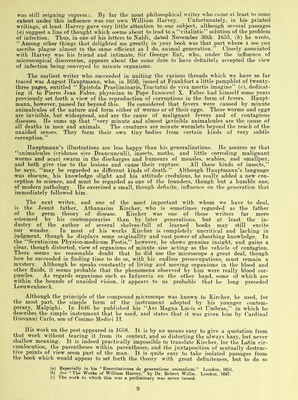
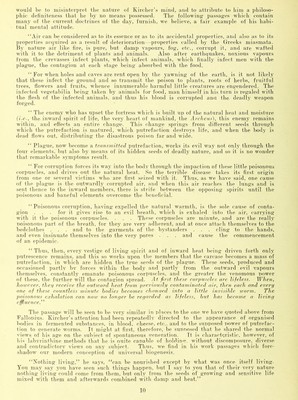
![would be to misiuteri)ret the iiatuie of Kirchei’s mind, and to attribute to biui a philoso- phic definiteness that he by no means possessed. The followino' passages which contain many of the current doctrines of the day, furnish, we believe, a fair example of his habi- tual mental attitude. “Air can he considered as to its essence or as to its accide-ntal properties, and also as to its ]n-operties acquired as a result of deterioration—properties called by the Greeks miasmata, ily nature air like fire, is pixre, hut damp vapours, fog, etc., corrupt it, aiul are wafted with it to the detriment of plants and animals. Also after earthquakes, noxious vapours from the crevasses iufect plants, which infect animals, which finally infect men with the plague, the contagion at each stage being absorbed with the food. “ For when holes and caves are rent open by the yawning of the earth, is it not likely that these infect the ground and so transmit the poison to plants, roots of herbs, fruitful trees, flowers and fruits, wlience innumerable harmful little creatures are engendered. The infected vegetabilia being taken by animals for food, man himself in his turn is reg’aled with the flesh of the infected animals, and thus his blood is corrupted and the deadly weapon forged. “ The enemy who has u])set the fortress which is built up of the natural heat and moisture (I.C., the inward spirit of life, the very heart of mankind, the Archeus), this enemy remains Avithin, and effects an entire change. This change springs from different seeds throngdi which the pxitrefaction is matured, which putrefaction destroys life, and Avhen the body is dead flows out, distributing the disastrous poison far and wide. “ Plague, now become a transmitted putrefaction, works its evil way not only throngdi the four elements, but also by means of its hidden .seeds of deadly nature, and so it is no wonder tluit remarkable symptoms result. “ For corruption forces its way into the body through the impaction of tliese little poisonous corpuscles, and drives out the natural heat, v'do the terrible disease takes its fir.st origin from one or sei’eral victims who are first seized with it. Thus, as we have said, one cause of the plague is the outwardly corrupted air, and when this air reaches the lungs and is sent thence to the inward members, there is strife between the o])posing sx>irits until the ])oisonous and baneful elements overcome the beneficial. “ Poisonous corruption, having expelled the natural warmth, is the sole cause of conta- gion . . . for it giims rise to an evil breath, which is exhaled into the air, cari’ying with it the poisonous coiqiuscles. . . . These corpuscles are minute, and are the really noisonous part of the breath, for they are very adherent, and at once attach themselves to the bedclothes . . . and to the garments of the by.standers . . . cling’ to the hands, and even insinuate themselves into the A*ery pores . . . and cause the commencement of an epidemic. “ Thus, then, every A’estige of living spirit and of inward heat being drh’en forth only putrescence remains, and this so works upon the members that the carcase becomes a mass of putrefaction, in which are hidden the true seeds of the plague. These seeds, produced and occasioned partly bv forces within the body and partly from the outward evil vapours themseh’es, constantly emanate poisonous corpuscles, and the greater the A’enomous nower of these, the further will the contagion spread. At first these corp'nscles are lifeless. When, hnwerer. they receive the outward heat from previon.sly contaminated air, then each and every one of these countless minnte bodies becomes chanaed into a little invisible icorm. The poisonous exhalation can now no lonyer be reyarded as lifeless, but has become a liviny effluence.” The passage will be seen to be very similar in places to the one we have quoted above from Fallopius. Kircher’s attention had been repeatedlv directed to the appearance of organised bodies in fermented substances, in blood, cheese, etc., and to the supposed power of putrefac- tion to generate worms. It might at fir.st, therefore, be supnosed that he shared the normal A'iews of his age on the subiect of spontaneous generation. It is characteri.stic. howei^er, of hie labyrinthine methods that he is nuite capable of holding, without discomposure, diverse and contradictorv views on any subject. Thus, we find in his ivork passages which fore- shadow our modern conception of universal biogenesis. “Nothing Ihung,” he says, “can be nourished except by what was once itself living. You may say you have seen .such things happen, but I say to you that of their very nature nothing living could come from them, but only from the seeds of growing and sensitive life mixed with them and afterwards combined with damp and heat.”](https://iiif.wellcomecollection.org/image/b22463392_0014.jp2/full/800%2C/0/default.jpg)
 No text description is available for this image
 No text description is available for this image
 No text description is available for this image