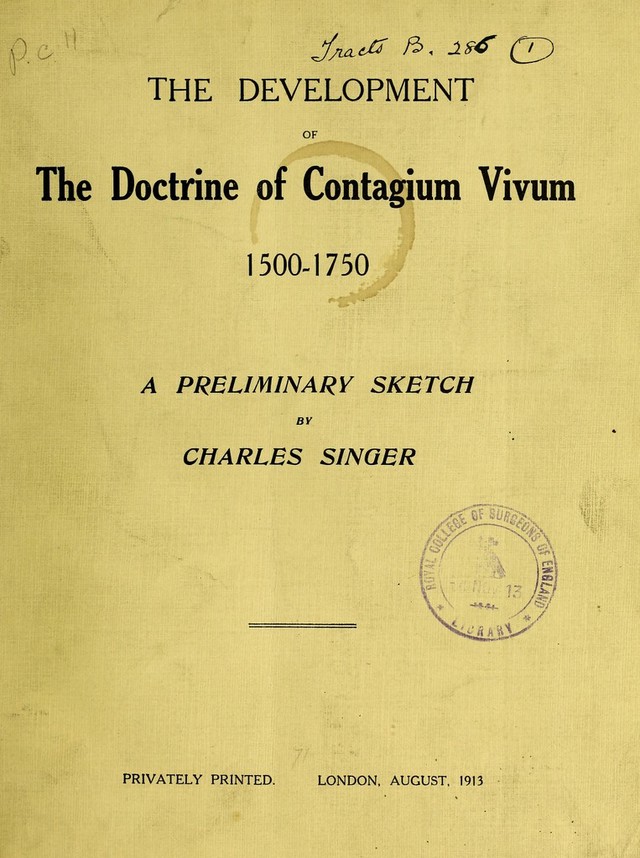
The development of the doctrine of contagium vivum 1500-1750 : a preliminary sketch / by Charles Singer.
- Charles Singer
- Date:
- 1913
Licence: In copyright
Credit: The development of the doctrine of contagium vivum 1500-1750 : a preliminary sketch / by Charles Singer. Source: Wellcome Collection.
Provider: This material has been provided by The Royal College of Surgeons of England. The original may be consulted at The Royal College of Surgeons of England.
16/18 page 14
![and drew the obvious conclusion. Tallisnieri obtained a good view of the corpuscles of the blood, and was, as we believe, the first to see both white and red corpuscles. He has also the merit of clearly realizing that the minute organisms which he believed to be the actual cause of infection were of an altogether different nature to the microscopic animalcula with which he wms acquainted. He appears, however, like numbers before and after him, to have regarded the corpuseles of the blood as the cause of disease. A similar error was made by llaiberti (a), who regarded the spermatozoa as the efficient agent of syphilis. Passing over a large number of writers who gave various presentations of our theory with varying degrees of success, we come to the year the date of the famous outbreak of plague at Marseilles. At that time Europe had long beQii free from that scourge, and the approach of the ancient enemy of the human race raised universal apprehension and interest. A vast literatiire arose on the subject in the language of every \Yestern country, and numerous were the measures suggested to prevent the spread of the disease. At the same time there was a large amount of speculative activity directed towards establishing a workable hypothesis as to the nature of the infection, and we find the years 1720-1725 peculiarly rich in this type of publication. From among this large literature we shall select only three names for discussion, the Englishmen, Benjamin Marten and llichard Bradley, ami the Frenchman, J. B. Goiffou. The first we will dismiss in a few words, as we have already given an account of his work elsewhere (6). More by luck than by wit he succeeded in evolving a most reasonable theory of the nature of consumption, in which there is even to this day little to correct. He was, so far as one can see, devoid of originality, but his solitary work shows him to have had well-developed, selective, and critical powers, which enabled him to piece together the best elements in the writings of others. In 1721, the year after the appearance of Marten’s work, appeared a small hook on “The Plague at Marseilles,” by Pichard Bradley (c). This work we regard as, on the whole, the best attempt to solve the problem of the nature of infection of any writer previous to Pasteur. Less iDhilosophical than either Lancisi or Tallisnieri, he had the advantage of writing at a slightly later date, when the theories put forward l)y the two brilliant Italians were still in men’s minds. The solution arrived at by Bradley is not (piite as complete as that of Marten. On tlie other hand, he shows vastly more first-hand knowledge, and his views are better reasoned and less the result of accident than those of his contemporary. Bradley is a greatly neglected writer, and even a])art from his views on plague, he is one wPo well repays study. He was a botanist, and certainly had inklings of the ]>art that insects play in the fertilization of plants, as well as of the sex character of flowers. It was the epidemics of macroscopic insects in plants that gave Bradley the clue to the nature of infection, just as it was his knowledge of the Acarus Scabiei that helped Marten to his views. The last, and perhaps the most remarkable, of the little group was Jean Baptiste Goitfon (1G58-1730). Goiffon was chief of the Board of Health at Marseilles at the time of the plague. Independently of the two English writers we have quoted, he arrived at a closely similar view of living contagion, and his works gave rise to considerable literature (d). From this time onward the history of the theory throughout the eighteenth century is one of progressive degradation—a process assisted by the publication of several absurd books in its support. The excellent work on “Antiseptics,” by Pringle and his followers, about the middle of the century, hardly comes within our purview. The theoi“;v’ had a silver age iinder Plenciz (e) and the Vienna School about 1700, and was travestied by Linnaeus if) and his pupils, who regarded infectious diseases as caiised by different types of Acarus. Scuderi {g), (n) J. H. RAIBERTI. Dissertatio medica de morbis venereis. Rome, 1722. (h) BENJAMIN MARTEN. A new theory of consumptions London, 1720. Nee CHARLES SINGER, in IJanus, February, 1911, and Lancet, March, 1911. (c) RICHARD BRADLEY. The Plague at Marseilles considered London, 1721. Another edition in the same year at Dublin. (d) JEAN BAPTISTE GOIFFON. Avertissement in “ Observations faites eur la Peste qui regne a present a Marseille et dans la Provence ’’ by Bertrand Lyon, 1721, also “ Relation et Dissertation sur la Peste du Gevaudan.” Lyon, 1722. (e) MARCUS ANTONIUS PLENCIZ. Opera Medico Physica Contagii Morborum Ideam Novam, Vienna, 1762. (f) LINNAEUS, see “ Fauna Sueeica,” 1746, also MICHAEL BAECKNER in Thesis “ Insectorum,” Holm, 1752, and JOHANNES NYANDER in Thesis “Exanthemata Viva.” UpsaJa, 1757. (f/) FRANCISCO MARIA SCUDERI. De Vario'larum Morborumque contagiosorum Naples, 1789.](https://iiif.wellcomecollection.org/image/b22463392_0018.jp2/full/800%2C/0/default.jpg)
 No text description is available for this image
 No text description is available for this image
 No text description is available for this image