An elementary text-book of botany / from the German of Dr. K. Prantl ; edited by S. H. Vines.
- Prantl, Karl Anton Eugen, 1849-1893.
- Date:
- 1886
Licence: Public Domain Mark
Credit: An elementary text-book of botany / from the German of Dr. K. Prantl ; edited by S. H. Vines. Source: Wellcome Collection.
Provider: This material has been provided by University of Bristol Library. The original may be consulted at University of Bristol Library.
19/360 page 7
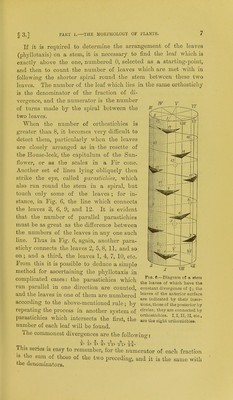
![§3.] If it is required to determine tlie arrangement of the leaves (phyllotaxis) on a stem, it is necessary to find tlie leaf wLich is exactly above the one, numbered 0, selected as a starting-point, and tlxen to count tbe number of leaves wlucb are met witb in following the shorter spiral round the stem between these two leaves. The number of the leaf which lies in the same orthostichy is the denominator of the fraction of di- vergence, and the numerator is the number of turns made by the spiral between the two leaves. When the number of orthostichies is greater than 8, it becomes very difficult to detect them, particularly when the leaves are closely arranged as in the rosette of the House-leek, the capitulum of the Sun- flower, or as the scales in a Fir cone. Another set of lines lying obliquely then strilce the eye, called parasticldes, which also run round the stem in a spiral, but touch only some of the leaves ; for in- stance, in Fig. 6, the line which connects the leaves 3, 6, 9, and 12. It is evident that the number of parallel parastichies must be as great as the difference between the numbers of the leaves in any one such liae. Thus in Fig. 6, again, another para- stichy connects the leaves 2, 5, 8, 11, and so on; and a third, the leaves 1, 4, 7, 10, etc. From this it is possible to deduce a simple method for ascertaining the phyllotaxis in complicated cases: the parastichies wliich run parallel in one direction are counted, and the leaves in one of them are numbered according to the above-mentioned rule; by repeating the process in another system of parastichies which intersects the first, the number of each leaf will be foujid. The commonest divergences are the followino-: ii2.3._»_ 8 13 , 3> B> 8> 13» ■2T» ir** Ihis series is easy to remember, for the numerator of each fraction IS tho sum of those of the two preceding, and it is the same with the denominators. Fig. 6.—Diagram of a stem the leaves of which have the constant divergence of f; tho leaves of the anterior surface are indicated by their inser- tions, those of the posterior by circles; they are connected by orthostichies. I, I, II, II, elc, are the eight orthostichies.](https://iiif.wellcomecollection.org/image/b21446064_0019.jp2/full/800%2C/0/default.jpg)



 No text description is available for this image
 No text description is available for this image
 No text description is available for this image