An elementary text-book of botany / from the German of Dr. K. Prantl ; edited by S. H. Vines.
- Prantl, Karl Anton Eugen, 1849-1893.
- Date:
- 1886
Licence: Public Domain Mark
Credit: An elementary text-book of botany / from the German of Dr. K. Prantl ; edited by S. H. Vines. Source: Wellcome Collection.
Provider: This material has been provided by University of Bristol Library. The original may be consulted at University of Bristol Library.
50/360 page 38
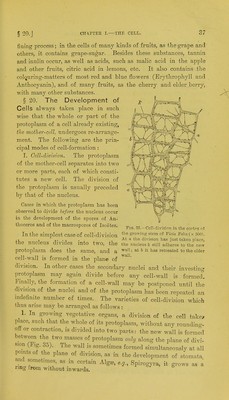
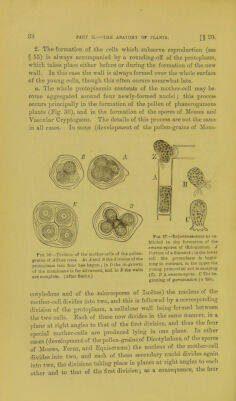
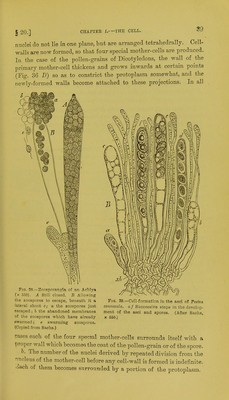
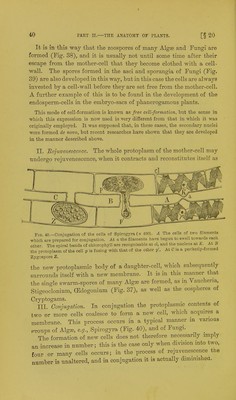
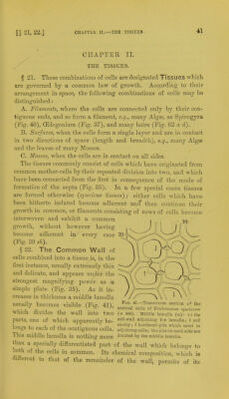
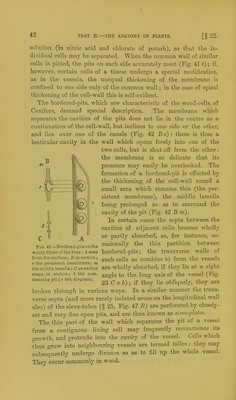
![2. The formation of the cells which subserve reproduHion (see § 55) is always accompanied by a rounding-off of the protoplasm., which takes place either before or during the formation of the new wall. In this case the wall is always formed over the whole surface of the young cells, though this often occurs somewhat late. a. The whole protoplasmic contents of the mother-cell may be- come aggregated around four newly-formed nuclei; this process occurs principally in the formation of the pollen of phanerogamoui- plants (Fig. 36), and in the formation of the spores of Mosses and Vascular Cryptogams. The details of this process are not the same in all cases. In some (development of the pollen-grains of ]\Iono- FlG. 36.—Division of the nnofher-cells of the pollen- grains of Altkcea rosea. At A and B the division of the protoplasm into four has begun ; in D the in-growth of the membrane is far advanced, and in E the walls are complete. (After Sachs.) Fig. 37.—Rejuvenescence as ex- hibited in the formation of the swarm-spores of ffidogoniura. A I'ortion of a filament; in the lower cell the protoplasm is begin- ning to contract, in the upper the young primordial cell is escaping (Z). B A swarm-spore. C The be- ginning of germination (x 350). cotyledons and of the microspores of Isoetes) the nucleus of the mother-cell divides into two, and this is followed by a corresponding division of the protoplasm, a cellulose wall being formed between the two cells. Each of these now divides in the same manner, in a plane at right angles to that of the first division, and thus the four special mother-cells are produced lying in one plane. In other cases (development of the pollen-grains of Dicotyledons, of the spores of Mosses, Ferns, and Equisetums) the nucleus of the mother-cell divides into two, and each of these secondary nuclei divides again into two, the divisions taking place in planes at right angles to each other and to that of the first division; as a consequence, the four](https://iiif.wellcomecollection.org/image/b21446064_0050.jp2/full/800%2C/0/default.jpg)
 No text description is available for this image
 No text description is available for this image
 No text description is available for this image