Qualitative chemical analysis / by C. Remigius Fresnius.
- Fresenius, C. Remigius, 1818-1897. Anleitung zur qualitativen chemischen Analyse. English
- Date:
- 1872
Licence: Public Domain Mark
Credit: Qualitative chemical analysis / by C. Remigius Fresnius. Source: Wellcome Collection.
31/442 page 9
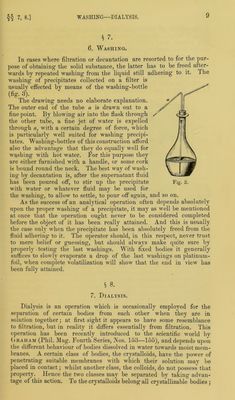
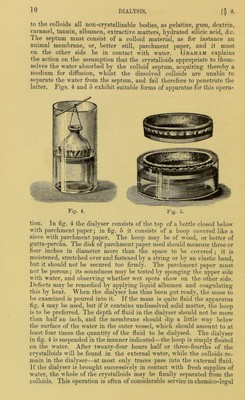
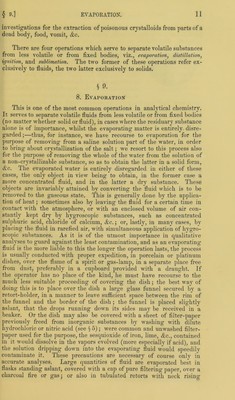
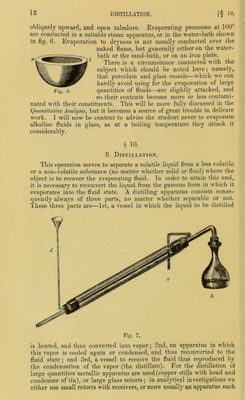
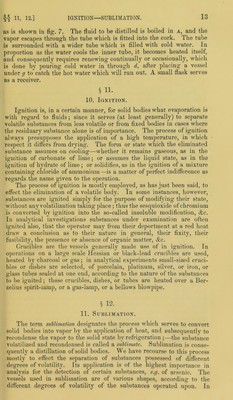
![§§ 7, 8.] WASHING—DIALYSIS. § 7. 6. Washing. In cases where flltration or decantation are resorted to for the pur- pose of obtaining tlie solid substance, the latter has to be freed after- wards by repeated washing from the liquid still adhering to it. I lie washing of precipitates collected on a filter is effected by means of the washing-bottle drawing needs no elaborate explanation. The outer end of the tube a is drawn out to a fine point. By blowing air into the flask through the other tube, a fine jet of water is expelled through a, with a certain degree of force, which is particularly well suited for washing precipi- tates. Washing-bottles of this construction afford also the advantage that they do equally well for washing with hot water. For this purpose they are either furnished with a handle, or some cork is bound round the neck. The best way of wash- ing by decantation is, after the supernatant fluid has been poured off, to stir up the precipitate Fig. 3. with water or whatever fluid may be used for the washing, to allow to settle, to pour off again, and so on. As the success of an analytical Operation often depends absolutely upon the proper washing of a precipitate, it may as well be mentioned at once that the Operation ouglit never to be considered completed before the object of it has been really attained. And this is usually the case only when the precipitate has been absolutely freed from the fluid adhering to it. The operator should, in this respect, never trust to mere belief or guessing, but should always make quite sure by properly-testing the last washings. With fixed bodies it generally suffices to slowly evaporate a drop of the last washings on platinum- foil, when complete volatilization will show that the end in view has been fully attained. usuaiiy (fig. 3). The § 8. 7. Dialysis. Dialysis is an Operation which is occasionally employed for the Separation of certain bodies from each other when they are in solution together; at first sight it appears to liave some resemblance to filtration, but in reality it differs essentially from flltration. This Operation has been recently introduced to the scientific world by Graham (Phil. Mag. Fourth Series, Nos. 153—155), and depends upon the different behaviour of bodies dissolved in water towards moistmem- branes. A certain dass of bodies, the crystalloids, liave the power of penetrating suitable membranes with which their solution may be placed in contact; whilst another dass, the colloids, do not possess that property. Hence the two classes may be separated by taking advan- tage of this action. To the crystalloids belong all crystallizable bodies ;](https://iiif.wellcomecollection.org/image/b28134709_0031.jp2/full/800%2C/0/default.jpg)
 No text description is available for this image
 No text description is available for this image
 No text description is available for this image