Surgical emergencies : together with the emergencies attendant on parturition and the treatment of poisoning : a manual for the use of general practitioners / by William Paul Swain.
- Swain, William Paul
- Date:
- 1874
Licence: Public Domain Mark
Credit: Surgical emergencies : together with the emergencies attendant on parturition and the treatment of poisoning : a manual for the use of general practitioners / by William Paul Swain. Source: Wellcome Collection.
Provider: This material has been provided by the Francis A. Countway Library of Medicine, through the Medical Heritage Library. The original may be consulted at the Francis A. Countway Library of Medicine, Harvard Medical School.
66/216 (page 54)
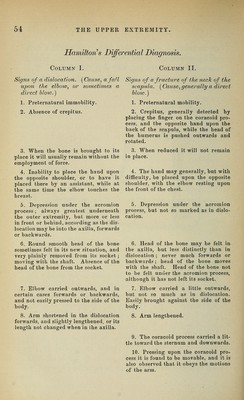
![Hamilton's Differential Diagnosis, Column I. Signs of a dislocation. [Cause^ afoJl u])on the elbow, or someti'mes a direct blow.) 1. Preternatural immobility. 2. Absence of crepitus. 3. When the bone is brought to its place it will usually remain without the employment of force. 4. Inability to place the hand upon the opposite shoulder, or to have it placed there by an assistant, while at the same time the elbow touches the breast. 5. Depression under the acromion process; always greatest underneath the outer extremity, but more or less in front or behind, according as the dis- location may be into the axilla, forwards or backwards. 6. Round smooth head of the bone sometimes felt in its new situation, and very plainly removed from its socket ; moving with the shaft. Absence of the head of the bone from the socket. 7. Elbow carried outwards, and in certain cases forwards or backwards, and not easily pressed to the side of the body. 8. Arm shortened in the dislocation forwards, and slightly lengthened, or its length not changed when in the axilla. Column II. Signs of a fracture of the neck of the Scapula. (Cause, generally a direct blow.) 1. Preternatural mobility. 2. Crepitus, generally detected by placing the finger on the coracoid pro- cess, and the opposite hand upon the back of the scapula, while the head of the humerus is pushed outwards and rotated. 3. When reduced it will not remain in place. 4. The hand may generally, but with difficulty, be placed upon the opposite shoulder, with the elbow resting upon the front of the chest. 6. Depression under the acromion process, but not so marked as in dislo- cation. 6. Head of the bone may be felt in the axilla, but less distinctly than in dislocation; never much forwards or backwards; head of the bone moves with the shaft. Head of the bone not to be felt under the acromion process, although it has not left its socket. 7. Elbow carried a little outwards, but not so much as in dislocation. Easily brought against the side of the body. 8. Arm lengthened. 9. The coracoid process carried a lit- tle toward the sternum and downwards. 10. Pressing upon the coracoid pro- cess it is found to be movable, and it is also observed that it obeys the motions of the arm.](https://iiif.wellcomecollection.org/image/b21079651_0066.jp2/full/800%2C/0/default.jpg)