[Report 1959] / Medical Officer of Health, Oxford City.
- Oxford (England). City Council. no2012034102.
- Date:
- 1959
Licence: Attribution 4.0 International (CC BY 4.0)
Credit: [Report 1959] / Medical Officer of Health, Oxford City. Source: Wellcome Collection.
6/168 page 6
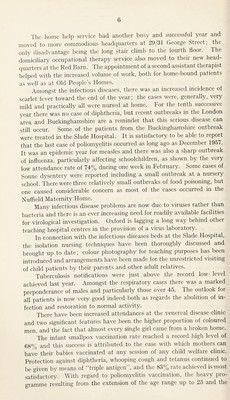
![The home help service had another busy and successful year and moved to more commodious headquarters at 29/31 George Street; the only disadvantage being the long stair climb to the fourth floor. The domiciliary occupational therapy service also moved to their new head¬ quarters at the Red Barn. The appointment of a second assistant therapxSt helped with the increased volume of work, both for home-bound patients as wel] as at Old People’s Homes. Amongst the infectious diseases, there was an increased incidence of scarlet fever toward the end of the year; the cases were, generally, very mild and practically all were nursed at home. For the tenth successive year there was no case of diphtheria, but recent outbreaks in the London area and Buckinghamshire are a reminder that this serious disease can still occur. Some of the patients from the Buckinghamshire outbreak were treated in the Slade Hospital. It is satisfactory to be able to report that the last case of poliomyelitis occurred as long ago as December 1957. It was an epidemic year for measles and there was also a sharp outbreak of influenza, particularly affecting schoolchildren, as shown by the very low attendance rate of 74% during one week in February. Some cases of Sonne dysentery were reported including a small outbreak at a nursery school. There were three relatively small outbreaks of food poisoning, but one caused considerable concern as most of the cases occurred in the Nufheld Maternity Home. Many infectious disease problems are now due to viruses rather than bacteria and there is an ever increasing need for readily available facilities for virological investigation. Oxford is lagging a long way behind other teaching hospital centres in the provision of a virus laboratory. In connection with the infectious diseases beds at the Slade Hospital, the isolation nursing techniques have been thoroughly discussed and brought up to date; colour photography for teaching purposes has been introduced and arrangements have been made for the unrestricted visiting of child patients by their parents and other adult relatives. Tuberculosis notifications were just above the record low level achieved last year. Amongst the respiratory cases there was a marked preponderance of males and particularly those over 45. The outlook for all patients is now very good indeed both as regards the abolition of in¬ fection and restoration to normal activity. There have been increased attendances at the venereal disease clinic and two significant features have been the higher proportion of coloured men, and the fact that almost every single girl came from a broken home. The infant smallpox vaccination rate reached a record high level of 68% and this success is attributed to the ease with which mothers can have their babies vaccinated at any session of any child welfare clinic. Protection against diphtheria, whooping cough and tetanus continued to be given by means of “triple antigen”, and the 83% rate achieved is most satisfactory. With regard to poliomyelitis vaccination, the heavy pro¬ gramme resulting from the extension of the age range up to 25 and the](https://iiif.wellcomecollection.org/image/b29942627_0006.jp2/full/800%2C/0/default.jpg)