A supplement to the first and second books of the History of Cornwall / [by R. Polwhele] ; containing remarks on St. Michael's Mount, Penzance, the Land's End, and the Sylleh Isles. By the historian of Manchester [i.e. J. Whitaker].
- Richard Polwhele
- Date:
- 1804
Licence: Public Domain Mark
Credit: A supplement to the first and second books of the History of Cornwall / [by R. Polwhele] ; containing remarks on St. Michael's Mount, Penzance, the Land's End, and the Sylleh Isles. By the historian of Manchester [i.e. J. Whitaker]. Source: Wellcome Collection.
26/176 page 26
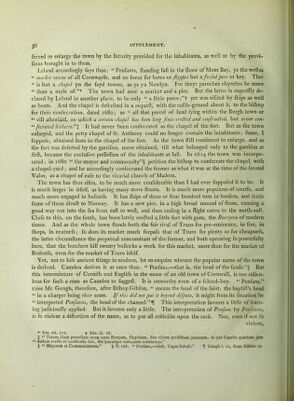
![A ftation, like the herald Mercury's, New-lighted on a heaven-killing hill. Yet fo the fa£! is. “ The firfh appearance of St. Michael,” as Worceftre informs us, from that belt of authorities afiuredly, the old legend, “ was on Mount Garganus, in the kingdom of Apulia, “ within the year of Chrift 391.”* But “ the fecond appearance,” he adds, “ was about the “ year of our Lord 710, on the tomb in Cornwall near to the SEA.”f Yet where in Corn- wall was this tomb? It is the prefent Mount of St. Michael there; we having already feen this defcribed in a charter of the Confeflor, as “ near to the fea ;” and Worceftre in another place fpeaking exprellly of “ the appearance of St. Michael on the mountain tomb, that was before “ called Le Hore-rok in the Wodd.”J And the French aver a third to have been made, on their St. Michael’s Mount in Normandy.§ To that in Cornwall, not as known from any fources of information vifited by Worceftre, but merely as notified by Camden from the intelligence of the monks here ;]| are thefe lines of Lyci- das pointed by Milton : Sleep’ll: by the fable of Belerus old. Where the great vision of the guarded mount Looks tow’rd Numancos and Bayona’s hold. As “ the great vifion” alludes to this very vifton of St. Michael, fo is “ the guarded mount” an appolite defignation of a mount, fo caftellated and fo garrifoned, as Camden fhews this to have been.^f But then Milton, in a poetical inattention to hiftorical proprieties, has confounded the latter times with the former, and carried up the military ufe of the Mount into the days of the archangel’s appearance. What is ftill more, though equally un-obferved by the criticks upon this poem, Milton has again confounded St. Michael’s Mount with the Land’s End ; in his hint concerning “ the fable of Belerus old,” glancing at the Belerium or Land’s End, yet fixing this “ where the great vifion of the guarded mount” is, and then giving St. Michael’s Mount the very pofition of the Land’s End. “ The inhabitants” here, as Camden informed Milton, “ report a “ watch-tower to have been formerly built” upon the extreme!! rocks, “ and to have pointed out “ the courfe to navigators by lighted fires.” *$ This, as Camden equally informed Milton, “ was “ undoubtedly a watch-tower ovcr-againjl Spain, fince Orofius has told us “ of a very lofty Pharus “ ere£ted at Brigantia in Gallicia—as a watch-tower again!! Britain.” f§ But Milton takes the notices and confounds them. He transfers the Mount to the Land’s End, and makes it the “ watch-tower over-againft Spain.” The watch-tower, we fee, is faid to look towards Spain ; but the Mount aftually looks toward France, its deep bay opening directly to the fouth. Yet D 2 Milton * P. 102. “ Prima apparicio Sandli Michaelis in Monte Gargano, in regno Apuliae, fuit anno Chrilti 391.” t Ibid. ibid. “ Secunda apparicio fuit circa annum Domini 710 in Tumba, in Cornubia, juxta mare.” Z Ibid. ibid. “ Apparcio Sanfti Michaelis in Monte Tumbi, antea vocata Le Hore-rok in the Wodd.” § Camden 137. “ Quod ad fuumGarganum Itali, et ad fuum Michaelis montem in Normannia Galli, cartatim rapiunt.” 11 Ibid. ibid. “ Monacho uni et alteri conftruxit [ccclefiam Edwardus, not (as Camden lays) Gulielmus for Robert “ Cornwalliae et Moritonii Comes,”] qui Micbaclem eo monte apparuifle prodiderunt.” ' If Ibid. ibid. Ibid. 136. t§ Ibid. ibid. “ Ad fpcculam proculdubio Hifpaniae, ut Orofius ‘ Briganti® Gallicise altiflimam Phatum—ad fpeculam ** Britannia credtam’ fuiffe prodidit.”](https://iiif.wellcomecollection.org/image/b22006242_0028.jp2/full/800%2C/0/default.jpg)

 No text description is available for this image
 No text description is available for this image
 No text description is available for this image