A surgical handbook : for the use of students, practitioners, house-surgeons, and dressers / by Francis M. Caird and Charles W. Cathcart.
- Caird, Francis Mitchell, 1853-1926
- Date:
- 1889
Licence: Public Domain Mark
Credit: A surgical handbook : for the use of students, practitioners, house-surgeons, and dressers / by Francis M. Caird and Charles W. Cathcart. Source: Wellcome Collection.
Provider: This material has been provided by The University of Leeds Library. The original may be consulted at The University of Leeds Library.
236/290 (page 224)
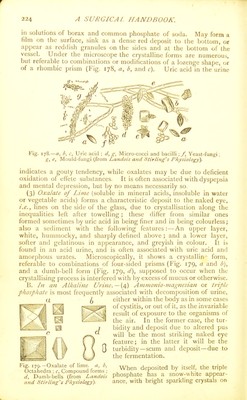
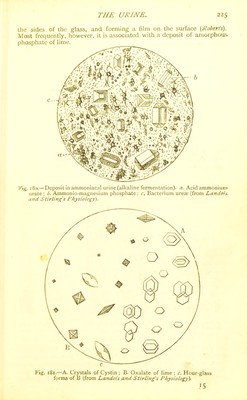
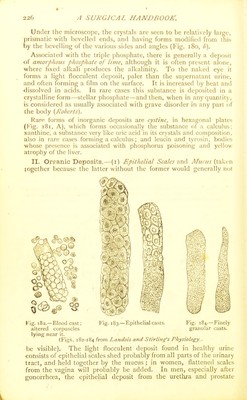
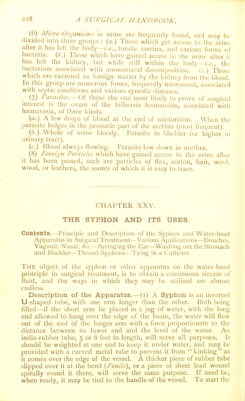
![r 224 A SURGICAL HANDBOOK. in solutions of borax and common phosphate of s(j(la. May form a lihn on the surface, sink as a dense red deposit to the bottom, or appear as reddish granules on the sides and at the bottom of the vessel. Under the microscope the crystalline forms are numerous, but referable to combinations or modifications of a lozenge shape, or of a rhombic prism (Fig. 178, a, b, and c). Uric acid in the urine Fig. 178.—n, /', f, Uric acid ; d, Micro-cocci and bacilli ; /, Yeast-fungi; g, e, Mould-fungi (from Landois and Utirling's Physiology). indicates a gouty tendency, while oxalates may be due to deficient oxidation of effete substances. It is often associated with dyspepsia and mental depression, but by no means necessarily so. (3) Oxalate of Lime (soluble in mineral acids, insoluble in water or vegetable acids) forms a characteristic deposit to the naked eye, i.e., lines on the side of the glass, due to crystallisation along the inequalities left after towelling; these differ from similar ones formed sometimes by uric acid in being finer and in being colourless; also a sediment with the following features:—An upper layer, white, hummocky, and sharjily defined above; and a lower layer, softer and gelatinous in ap]3earance, and greyish in colour. It is found in an acid urine, and is often associated with uric acid and amorphous urates. Microscopically, it shows a crystallin ■ form, referable to combinations of four-sided prisms (Fig. 179, a and b), and a dumb-bell form (Fig. 179, d), supposed to occur when the crystallising process is interfered with by excess of mucus or otherwise. B. In an Alkaline Urine. —{£,) Aninionio-tiiai^nesia7i or tt-iple phosphale is most frequently associated with decomposition of urine, either within the body as in some cases of cystitis, or out of it, as the invariable result of exposure to the organisms of the air. In the former case, the tur- bidity and deposit due to altered pus will be the most striking naked eye feature; in the latter it will be the turbidity—scum and deposit—due to the fermentation. When deposited by itself, the triple phosphate has a snow-white appear- ance, with bright sparkling ciystals on Fig. 179.—Oxalate of lime, a, b. Octahedra ; r, Compound forms ; d. Dumb-bells (from Landois and Siirliiig's Physiology).](https://iiif.wellcomecollection.org/image/b21514124_0236.jp2/full/800%2C/0/default.jpg)