A surgical handbook : for the use of students, practitioners, house-surgeons, and dressers / by Francis M. Caird and Charles W. Cathcart.
- Caird, Francis Mitchell, 1853-1926
- Date:
- 1889
Licence: Public Domain Mark
Credit: A surgical handbook : for the use of students, practitioners, house-surgeons, and dressers / by Francis M. Caird and Charles W. Cathcart. Source: Wellcome Collection.
Provider: This material has been provided by The University of Leeds Library. The original may be consulted at The University of Leeds Library.
238/290 (page 226)
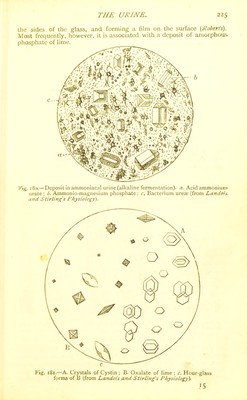
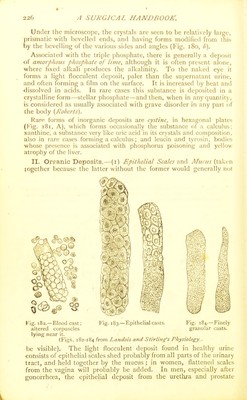
![Under the microscope, the crystals are seen to be relatively large, prismatic with bevelled ends, and having; forms modified from this by the bevelling of the various sides and angles (I'ig. i8o, //). Associated with the triple ])hosphale, there is generally a deposit of amoi-phons phosphate of lime, although it is often present alone, where fixed alkali ])roduces the alkalinity. To the naked eye it forms a light flocculent deposit, paler than the supernatant urine, and often forming a fdm on the surface. It is increased by heat and dissolved in acids. In rare cases this sul)stance is de]iosiled in a crystalline form—stellar phosphate—and then, when in any tjuanlity, is consitlered as usually associated with grave disorder in any pari of the body {Roheiis). Rare forms of inorganic deposits are cystine, in hexagonal plates (Kig. i8r, A), which forms occasionally the substance of a calculus; xanthine, a substance very like uric acid in its crystals and composition, also in rare cases forming a calculus; and leucin and tyrosiii, bodies whose presence is associated with phosphorus poisoning and yellovv atrophy of the liver. II. Organic Deposits.—(i) Epithelial Scales yl/?/r//j-(taken together because the latter without the former would generally not Kig. 182. —Plood cast; Fig. 183.—Epithelial casts. Fig. 184.—Finely altered corpuscles granular c.asts. lying near it. (Figs. 182-184 from Landois atid Stirling's Physiology . be visible). The light flocculent deposit found in healthy urine consists of epithelial scales shed probably from all parts of the urinary tract, and held together by the mucus; in women, flattened scales from the vagina will probably be added. In men, especially after gonorrhoea, the epithelial deposit from the urethxa and prostate](https://iiif.wellcomecollection.org/image/b21514124_0238.jp2/full/800%2C/0/default.jpg)