A surgical handbook : for the use of students, practitioners, house-surgeons, and dressers / by Francis M. Caird and Charles W. Cathcart.
- Caird, Francis Mitchell, 1853-1926
- Date:
- 1889
Licence: Public Domain Mark
Credit: A surgical handbook : for the use of students, practitioners, house-surgeons, and dressers / by Francis M. Caird and Charles W. Cathcart. Source: Wellcome Collection.
Provider: This material has been provided by The University of Leeds Library. The original may be consulted at The University of Leeds Library.
244/290 (page 232)
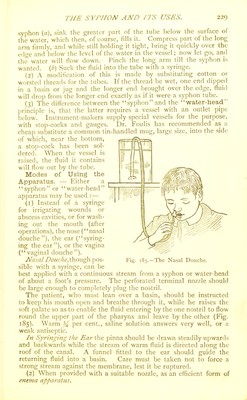
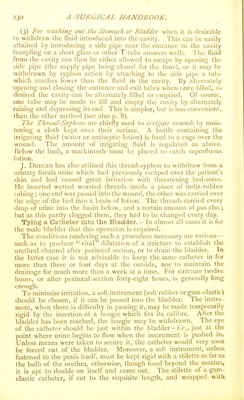
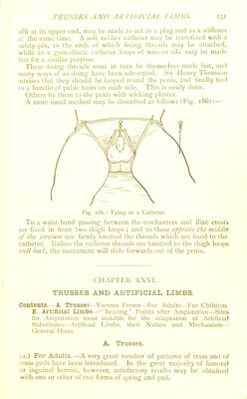
![(1) The spiral spring, single or double. (2) The Salmon and Ody, or oj)posite-sided truss. (1) 'J'/ie Siiig/c Spiral 'J'riiss.—In this, the spring has the spiral part chiefly near the pad; the spring encircles two-thirds of the body below the iliac crests, leaving out the front of the abdomen, where a strap unites the two ends. A jierinaeal strap to keep the apparatus <lown may be used, but is seldom necessary. The pad is usually of horse-hair, covered with leather. Cole's pad is borne on a coiled spiral spring fixed to the end of the truss spring; others have advocated pads of solid india-rubber, or made in the form (jf bags containing air, water, or glycerine. The form of the pad with the spiral truss is generally pyriform, with the broad part below. A horse-shoe shape is sometimes employed for an inguinal hernia, especially with a partly descended testis. For large .scrotal herni;v, the pad is sometimes prolonged downwards. For a femoral licrnia the pail comes further down than it does for an inguinal hernia. The direction of the jiad's pressure for an inguinal hernia is obliquely upwards, backwards, and outwards, and nearly directly backwards for a femoral hernia; the pad in the latter case coming nearly vertically downwards from the end of the spring, instead of obliquely downwards and inwards as in the former case. In a double spiral truss, both ends of the spring end in a pad. Double trusses are to 1)0 used—not only where there is a double hernia, but where with a single hernia the canal of the opposite side is weak. In such cases of two possible evils—viz., opening up of a weak canal l)y descent of intestine, and absorption of parts by the pressure of the truss—we cfjnsider the latter to be the less. (2) The Salmon and Ody Truss (single), has a pad behind at the spine as well as one in front. It is also called the opposite-sided truss, because its s]iring passes from the spine round the front of the body on the side opposite to the hernia, and thus crosses the middle line in front to reach the hernia. This gives it great security. It is chiefly used for femoral hernia, though it may be applied for inguinal hernia also. pad is usually circular in shape, fixed to the spring by a ball and socket joint. A perina.'al strap is generally worn. A doulile Salmon and Ody truss has a double pad behind, with the spring pas.sing round each side to end in a ]iad on its own side, li is thus, when double, not an opposite-sided truss. In Jit ting a truss for inguinal or femoral hernia, the instrument- maker must see that no pressure is borne on the pubes. In inguinal hernia, the pressure must be mainly at the internal ring and along ihe canal; in femoral hernia, it must be vertically backwards on the femoral canal. The truss should be worn constantly by day, and by night also— if the patient be subject to coughing. During temporary removal, the patient should be in the horizontal position, and the vertical position of the trunk should not be resumed without the tru.ss.](https://iiif.wellcomecollection.org/image/b21514124_0244.jp2/full/800%2C/0/default.jpg)