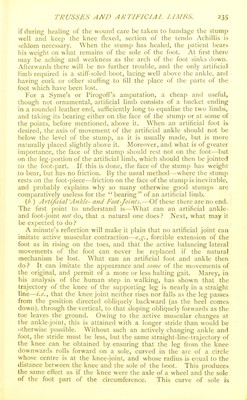
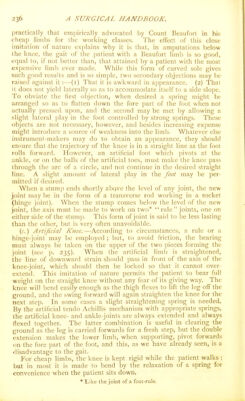
A surgical handbook : for the use of students, practitioners, house-surgeons, and dressers / by Francis M. Caird and Charles W. Cathcart.
- Caird, Francis Mitchell, 1853-1926
- Date:
- 1889
Licence: Public Domain Mark
Credit: A surgical handbook : for the use of students, practitioners, house-surgeons, and dressers / by Francis M. Caird and Charles W. Cathcart. Source: Wellcome Collection.
Provider: This material has been provided by The University of Leeds Library. The original may be consulted at The University of Leeds Library.
250/290 (page 238)
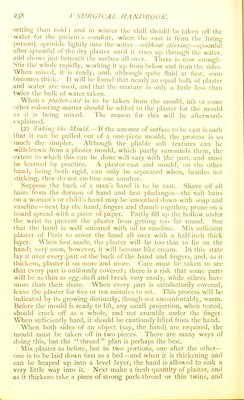
![selling than cold; and in winter tiie chill should he taken off Ihe -water fur the i)atienl s comfort, when the cast is from the living ■person), sprinl<le liglitly into the water—<wV/w/// ,s7/;-/-/;/<'-—spoonful after spoonful of the dry plaster until il rises u]) through the water, and shows just beneath the surface all over. There is now enough. Stir tile \yhole ra])idly, working il up from below and from the sides. When mixed, it is ready, and, although (piile lluid at lirst, soon becomes thick. It will be found that nearly an ecpial hulk of ])laster and water are used, and thai the mi.Mure is only a little less than twice the hulk of water taken. When a plaHer-cast is to he taken from the mould, ink or some other colouring-matter should be added to the plaster for the mould as it is being mi.xed. The reason for this will be afterwards • explained. (2) 'I'akiiii^ iJiti Mould. —If the amount of surface to be cast is such that it can he pulled out of a one-piece mould, the process is so 'much the simpler. Although the pliable soft textures can he withdrawn from a jjlaster mould, which partly surrounds them, the extent to which this can be done will vary with the part, and must he learned by practice. A plaster-ca.st and mould, on the other hand, being both rigid, can only he .separated when, besides not sticking, they do not enclose one another. ' Suppose the back of a man's hand is to be cast. Shave off all hairs from the dorsum of hand and lirst ])halanges—the soft hairs on a woman's or child's hand may be smoothed down with soap and vaseline —m.'xt lay the hand, fingers and thumb together, ]3rone (jn a hoard spread with a piece of paper. Partly lill u]) the hollow under the wrist to ])revent the plaster from getting too far round. See that the hand is well smeared with oil or vaseline. Mix sufficient I)laster of I'aris to cover the hand all over with a half-inch thick layer. When lirst made, the plaster will he too thin to lie on the hand; very soon, however, it will become like cream. In this state lay it (jver every .jxirt of the l)ack of the hand and lingers, and, as it thickens, i)laster it on more and more. Care must he taken to see that every ]mrt is uniformly covered; tliere is a risk that some ]3arts will be as thin as egg-sliell and break very easily, while others have more than their share. When every ]iart is satisfactorily covered, leave the pLaster for five or ten minutes l(j set. This process will be indicated by its growing distinctly, though ncjt uncomfortably, warm. Before the mould is ready to lift, any small projection, when tested, should crack off as a whole, and not crumble under the finger. When sufficiently hard, it should be cautiously lifted from the hand. When hoth sides of an object (say, the hand) are required, the mould must l^e taken off in two pieces. There are many ways of doing this, hut the thread plan is perhaps the best. ' Mix i)laster as before, but in two portions, one after the other— one is to be laid down first as a bed—and when it is thickening and can be heaped up into a level layer, the hand is allowed to sink a very little way into it. Next make a fresh quantity of plaster, and as it thickens take a piece of strong pack-thread or thin twine, ami](https://iiif.wellcomecollection.org/image/b21514124_0250.jp2/full/800%2C/0/default.jpg)