The micro-organisms of the human mouth : The local and general diseases which are caused by them.
- Miller, Willoughby Dayton, 1854-1907.
- Date:
- 1890
Licence: Public Domain Mark
Credit: The micro-organisms of the human mouth : The local and general diseases which are caused by them. Source: Wellcome Collection.
Provider: This material has been provided by The University of Leeds Library. The original may be consulted at The University of Leeds Library.
28/402 (page 2)
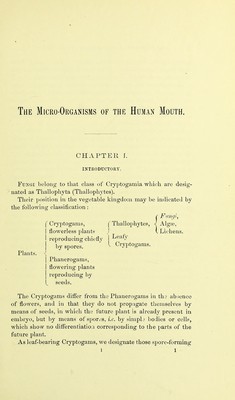
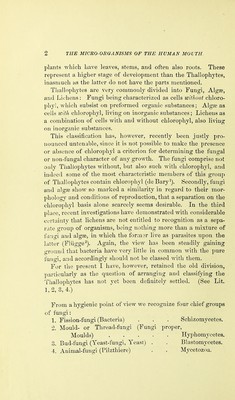
![plants which have leaves, stems, and often also roots. These represent a higher stage of development than the Thallophytes, inasmuch us the latter do not have the parts mentioned. Thallophytes are very commonly divided into Fungi, Algse, and Lichens: Fungi being characterized as cells without chloro- pliy], which subsist on preformed organic substances ; Algae as cells with chlorophyl, living on inorganic substances; Lichens as a combination of cells with and without chlorophyl, also living on inorganic substances. This classification has, however, recently been justly pro- nounced untenable, since it is not possible to make the presence or absence of chlorophyl a criterion for determining the fungal or non-fungal character of any growth. The fungi comprise not only Thallophytes without, but also such with chlorophyl, and indeed some of the most characteristic members of this group of Thallophytes contain chlorophyl (deBary^). Secondly, fungi and algse show so marked a similarity in regard to their mor- phology and conditions of reproduction, that a separation on the chlorophyl basis alone scarcely seems desirable. In the third place, recent investigations have demonstrated with considerable certainty that lichens are not entitled to recognition as a sepa- rate group of organisms, being nothing more than a mixture of fangi and algse, in which the former live as parasites upon the latter (Fliigge^). Again, the view has been steadily gaining ground that bacteria have very little in common with the pure fungi, and accordingly should not be classed with them. For the present I have, however, retained the old division, particularly as the question of arranging and classifying the Thallophytes has not yet been definitely settled. (See Lit. 1,2,3, 4.) From a hygienic point of view we recognize four chief groups of fungi: 1. Fission-fungi (Bacteria) . . . Schizomycetes. 2. Mould- or Thread-fungi (Fungi proper. Moulds) Hyphomycetes. 3. Bud-fungi (Yeast-fungi, Yeast) . . Blastomycetes, 4. Animal-fungi (Pilzthiere) . . Mycetozoa.](https://iiif.wellcomecollection.org/image/b21515074_0028.jp2/full/800%2C/0/default.jpg)