A treatise on the diseases of the eye / by W. Lawrence.
- Sir William Lawrence, 1st Baronet
- Date:
- 1854
Licence: Public Domain Mark
Credit: A treatise on the diseases of the eye / by W. Lawrence. Source: Wellcome Collection.
Provider: This material has been provided by the Francis A. Countway Library of Medicine, through the Medical Heritage Library. The original may be consulted at the Francis A. Countway Library of Medicine, Harvard Medical School.
51/996 (page 41)
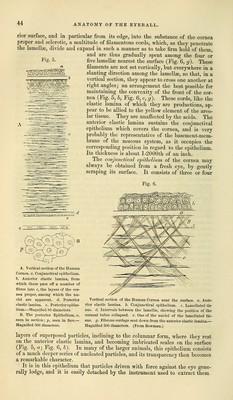
![Cornea.—[4, Fig. 1, and d, Fig. 2.] The cornea,1 which covers one-sixth of the globe, differs widely in appearance from the sclerotica, but resembles it in the firmness and resistance of its structure. Thus it is fitted to protect the exposed anterior portion of the eye, while its perfect transparency allows the free passage of light into the interior of the globe. No force applied by the fingers or forceps can lacerate it, although, externally, it appears a delicate kind of membrane. The cornea and sclerotic are so firmly united, that they may, to all intents and purposes, be considered as one continued investment of the eye; as consti- tuting a kind of case for lodging and protecting the more delicate essential structures of the organ. They may, indeed, be separated by long maceration,3 but in the recent subject, the resistance is as great at the line of junction as at any other part, and we may consider them as consolidated into one substance. The sclerotica is brought to a thin edge at its anterior termination, and the cir- cumference of the cornea ends by a similar margin; but the former is bevelled off on the inside, and the latter on the outside, so that the sclerotica overlaps the cornea at the point of union. Hence the circumference of the cornea is smaller externally than internally: hence, too, the anterior chamber extends beyond the external circumference of the cornea. In some points of structure there is a striking difference between the cornea and the sclerotic. The former is composed of several layers, connected by cellu- lar tissue, in the interstices of which there is a small quantity of clear fluid: this can be squeezed out in minute drops, when the cornea of a recent eye is divided. If we make an incision into the substance, we can turn back with the forceps several successive laminae; these, however, are quite artificial, being more or less numerous, according to the pains we take in the preparation of them. The facility with which the several portions are separated in such a dis- section, and the freedom with which they glide over each other when squeezed between the finger and thumb, show that the component parts of this membrane are loosely connected together. In consequence of this loose and spongy structure, the cornea swells when soaked in water. The texture of the layers, when torn up in the manner described, is fibrous; and we must refer the cornea to that class of structures. Although the sclerotic and cornea are so different in external appearance, and on cursory examination, arguments may be adduced in favor of the opinion formerly entertained, that they are merely parts of one continuous structure. The essential character of the tissue in both is fibrous; the circulating vessels are few and small in both. There is little dif- ference between them in the early periods of foetal existence, when the cornea is opaque. When examined with the microscope they are nearly alike, both consisting, in great part, of minute lymphatic vessels arranged in the form of a close network, and continued from one membrane into the other.3 Again, the cornea is frequently so assimilated to the sclerotica by morbid change, that the boundary between them can no longer be traced. [The following representation of a vertical section of the sclerotic and cornea (Fig. 3), from Todd and Bowman's Physiological A natomy, shows the continuity of their tissue. These physiologists state that, at their line of junction, the fibres, which in the sclerotic have been densely interlaced in various directions, 1 i'iiklius, «6er die durchxichtige Ilornhaut, Carlsruhe, 1818 ; ClBMBHB, Tunica Cornea, d lluiimris iK/mi Mniingntjihia plnjsiologico-pathologica, Goetting, 181G. Also in Radius, Scriptures Opkthal. v. 1. 2 [We have not ourselves been able to effect the separation of the sclerotica from Che cornea by maceration; Dr. Bowman says, it is not to be accomplished; :m<l it' we r..n- sider the close affinities of the two structures and their mode of union, it will be easy to understand the reason of this.] 3 ABB OLD'8 Untcrsuchungcn, p. 1G and 23.](https://iiif.wellcomecollection.org/image/b21063539_0051.jp2/full/800%2C/0/default.jpg)