On the neglect of physical education and hygiene : by Parliament and the educational department, as the principle cause of the degeneration of the population, of the excessive infantile & general mortality, and of many diseases and deformities; with an abstract of a report on the present state of physical education on the continent, by Doctor Roth's special commissioner; and suggestions relative to the introduction of these neglected branches of national education / by Dr. Roth.
- Mathias Roth
- Date:
- 1879
Licence: Public Domain Mark
Credit: On the neglect of physical education and hygiene : by Parliament and the educational department, as the principle cause of the degeneration of the population, of the excessive infantile & general mortality, and of many diseases and deformities; with an abstract of a report on the present state of physical education on the continent, by Doctor Roth's special commissioner; and suggestions relative to the introduction of these neglected branches of national education / by Dr. Roth. Source: Wellcome Collection.
Provider: This material has been provided by UCL Library Services. The original may be consulted at UCL (University College London)
37/104 page 27
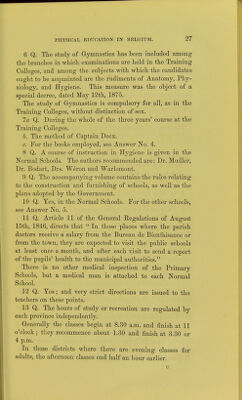
![6 Q. The study of Gymnastics has been included among the branches in which examinations are held in the Training Colleges, and among the subjects with which the candidates ought to be acquainted are the rudiments of Anatomy, Phy- siology, and Hygiene. This measure was the object of a special decree, dated May 12th, 1875. The study of Gymnastics is compulsory for all, as in the Training Colleges, without distinction of sex. 7a Q. During the whole of the three years' course at the Training Colleges. b. The method of Captain Docx. c. For the books employed, see Answer No. 4. 8 Q. A course of instruction in Hygiene is given in the Normal Schools, The authors recommended are: Dr. Mealier, Dr. Bodart, Drs. Weron and Wai'lomont. 9 Q. The accompanying volume contains the rules relating to the construction and furnishing of schools, as well as the plans adopted by the Government. 10 Q. Yes, in the Normal Schools. For the other schools, see Answer No. 5. HQ. Article 11 of the General Regulations of August 15th, 1846, directs that In those places where the parish doctors receive a salary from the Bureau de Bienfaisance or from the town, they are expected to visit the public schools at least once a month, and after each visit to send a report of the pupils' health to the municipal authorities. There is no other medical inspection of the Primary Schools, but a medical man is attached to each Normal School. ] 2 Q. Yes; and very strict directions are issued to the teachers on these points. 13 Q. The hours of study or recreation are regulated by each province independently. Generally the classes begin at 8.30 a.m. and finish at 11 o'clock; they recommence about 1.30 and finish at 3.30 or 4 p.m. In those districts where there are evening classes for adults, the afternoon classes end half an hour earlier. c](https://iiif.wellcomecollection.org/image/b21289797_0037.jp2/full/800%2C/0/default.jpg)


 No text description is available for this image
 No text description is available for this image
 No text description is available for this image