The principles and practice of hydrotherapy : a guide to the application of water in disease for students and practitioners of medicine / by Simon Baruch ... ; with numerous illustrations.
- Simon Baruch
- Date:
- 1898
Licence: Public Domain Mark
Credit: The principles and practice of hydrotherapy : a guide to the application of water in disease for students and practitioners of medicine / by Simon Baruch ... ; with numerous illustrations. Source: Wellcome Collection.
Provider: This material has been provided by the Harvey Cushing/John Hay Whitney Medical Library at Yale University, through the Medical Heritage Library. The original may be consulted at the Harvey Cushing/John Hay Whitney Medical Library at Yale University.
185/456 page 171
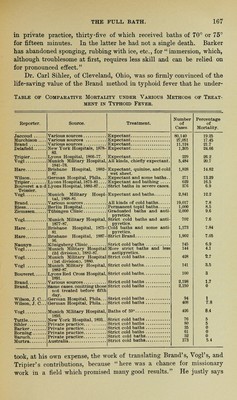
![granular and fatty metamorphosis of the liver and kidneys. Indeed, there is an entire absence of good effect upon the circulation after an- tipyrin, an effect which is marked after the cold bath. In the discussion of this subject, at the instance of Dujardin- Beaumetz, by the Paris Congress of Therapeutics a few years ago, Lepine stated that his investigations showed conclusively that all anti- pyretics, the effect of which is so palpably soothing to the nervous system, act by inhibiting the activity of the protoplasm; they destroy chiefly the red corpuscles, either by converting the haemoglobin or by attacking the cell structure itself; they act as poison to the protoplasm. Desplats, though favoring medicinal antipyretics in fevers of short duration, favored most decidedly the strict cold bathing of Brand in continued fevers with a tendency to adynamia or ataxia. Stokvis and Semmola spoke of medicinal antipyretics as dangerous remedies. Semmola thought that whatever comfort is induced by them is pur- chased at the expense of weakening the patient. The matter stands quite differently with the Brand method, which even in the modified and emasculated forms which prevail is far more effective. Dr. Shattuck, Jackson Professor of Practice in Harvard University, says* it is certain that the modified and feeble bath treatment practised in this country cannot compare iu results with the strict Brand method, because the former still shows a mortality of ten per cent. Dr. Horatio C. Wood, who, as Professor of Therapeutics in the University of Pennsylvania may be regarded as a safe counsellor, says with reference to Brand's method: I have no doubt that very many persons in the United States have died of typhoid fever whose lives would have been saved if the American medical profession had risen above the opposition of the laity and above its own prejudices. Juhel-Renoy, the late eminent Parisian physician, claims that even in old people the only effectual treatment is by the cold bath, from which he has obtained such marvellous results that they amounted to resurrections in some cases, f Dr. H. A. Hare, Professor of Therapeutics in Jefferson Medical College, I furnishes a judicious exposition of this subject. On page 62 he says: The writer feels sure that antipyrin should be given in ty- phoid and other low fevers of a continued type only when the cold pack [with which he evidently includes bathing] cannot be used, or at the end of the cold application, to prevent the temperature from * Boston Medical and Surgical Journal, p. 604, 1894. f Bulletin de Therapie, p. 530, 1895. i Boylston prize essay on Fever: Pathology and Treatment by Antipy- retics.](https://iiif.wellcomecollection.org/image/b21034825_0185.jp2/full/800%2C/0/default.jpg)