Telliamed, or, The world explain'd : containing discourses between an Indian philospher and a missionary, on the diminution of the sea, the formation of the earth, the origin of men & animals : and other singular subjects, relating to natural history & philosphy ; a very curious work.
- Maillet, Benoît de, 1656-1738. Telliamed. English
- Date:
- 1797
Licence: Public Domain Mark
Credit: Telliamed, or, The world explain'd : containing discourses between an Indian philospher and a missionary, on the diminution of the sea, the formation of the earth, the origin of men & animals : and other singular subjects, relating to natural history & philosphy ; a very curious work. Source: Wellcome Collection.
Provider: This material has been provided by the National Library of Medicine (U.S.), through the Medical Heritage Library. The original may be consulted at the National Library of Medicine (U.S.)
33/280
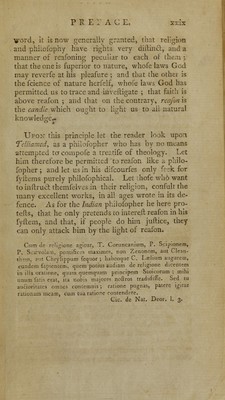
![moment it is rcquifite for him to ufe the utmofl efforts of his power to fuftam it. Befides, he will readily acknowledge, that the work of preferva- tion, is truly, the work of the hand of God ; that nothing happens in the world without his permif- fion, and in conformity to hi* eternal decrees ; and that among all the lecond caufes, there is not one which is not fubordinate to his omnipotent will. The defenders of the aclual divine concur- rence will not be content with this concemon.— But is not this, perhaps, as much a fault in their manner of thinking, as in that of our philofopher ? Can they refufe to grant, that the operations of God do by no means referable any thing that is fuggefted by our weak and (hallow ideas ? And upon this principle, is it not evident, that they at- tribute to the Deity a providence no more than purely human, and bounded by hours and mo- ments, fuch as we may conceive in a wife man ? Is not a providence, thus limited and imperfect, a providence, the end of which is nothing elfe than to make God the author of fin, and to fap the foundations of morality,]; infinitely unworthy of a fovereignly perfect being ? Can we more effec- tually honor this Supreme intelligence, than in dif- engaging him from the flavery to which thefe bafe and fervile ideas feem to reduce himj If, however, there mould remain any fcruples with refpecl to thefe points, every one is at liberty to look upon what Telliamed has wrote on them as the diver/ion of his mind, founded on conjeflures, on fome phenomena, or on confequences very remote from the folidity of the proofs, which he advances for the diminution of the fea. The pro- t This is what the difciples of Defcartes and Malbranchc are upbraided with.](https://iiif.wellcomecollection.org/image/b21138722_0033.jp2/full/800%2C/0/default.jpg)