Water supply : considered mainly from a chemical and sanitary standpoint / by Wm. Ripley Nichols.
- William Ripley Nichols
- Date:
- 1883
Licence: Public Domain Mark
Credit: Water supply : considered mainly from a chemical and sanitary standpoint / by Wm. Ripley Nichols. Source: Wellcome Collection.
127/252 (page 113)
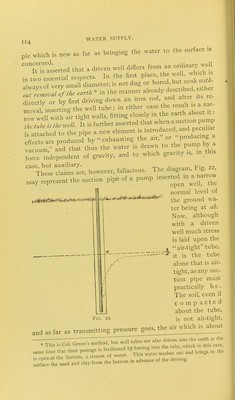
![the water is to be taken. The pipes are generally from iH to 2 inches in diameter, and furnished at the lower end with a wrought- iron or steel point; above this point the pipes are perforated for some distance with holes to admit the water. The pipes with point attached may be driven with a mallet or falling weight, and when the top of one tube has reached the surface of the ground, a second length is attached to it with a common coup- ling, and the driving continued to the desired depth. In many localities it is better to first drive down a suitable steel-pointed rod or drill until water is reached, and to insert the well-tube in the hole thus made.* In the perforated points for such wells the greatest variety exists, it being stated that about 150 patents have been issued for points and cognate portions of the pipe. 1 he figure represents that known as Andrews' Patent ■111 ^'•'HfWifrWifVniiii FlG. 21.—DRIVEN WELL POINT. Although pipes of larger dimensions than those mentioned are sometimes driven, it is usual when a large amount of water is required-as for manufacturing purposes or for town sup- ply-to drive a number of wells in the same limited area, and connect, them to a common suction pipe leading to the pump. The driven well partakes of the character of the shallow well when lts of supp]y is the ground wat^ b^ ^ akes of the character of the artesian well, as when it is driven hrough a layer of clay or other impervious material underlying the ground water into another water-bearing stratum below. vZ i^rLTll f°rCed int° th£ £r°Und Water> and Is has alreT. K 7 th° CffeCt the wei? The Hr bCeVeSCribed (P^s 109-112) with an open well. The driven well is valuable as a means of obtaining water on account of facility of construction, but it involves no the patent Sntldated by, ^ *^ 11 * ^r, that and by British Letter^'JjTt * <° James Su^ March 29, 1864, uers latent granted to John Goode, Oct. 16, 1823.](https://iiif.wellcomecollection.org/image/b20403823_0127.jp2/full/800%2C/0/default.jpg)