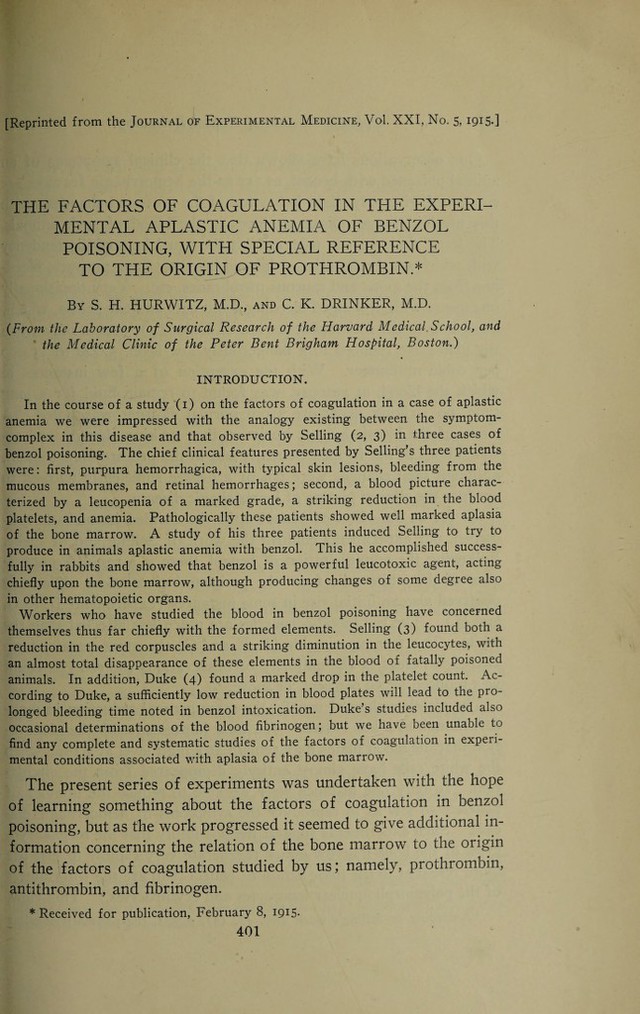
The factors of coagulation in the experimental aplastic anemia of Benzol poisoning : with special reference to the origin of prothrombin / by S.H. Hurwitz, M.D., and C.K. Drinker, M.D.
- Hurwitz, S. H.
- Date:
- [1915?]
Licence: In copyright
Credit: The factors of coagulation in the experimental aplastic anemia of Benzol poisoning : with special reference to the origin of prothrombin / by S.H. Hurwitz, M.D., and C.K. Drinker, M.D. Source: Wellcome Collection.
4/28 page 402
![Our observations have shown that the clinical symptoms of an animal poisoned with benzol, as far as the hemorrhagic features are concerned, give only slight indication of the profound changes which] this myeloid tissue poison produces in the blood of such animals. The latter do not, as a rule, exhibit the usual hemophilic tendency with which we are familiar,—delayed bleeding time, purpura, bleed- f ing from the gums and mucous membranes, etc. Very occasionally one meets with prolonged bleeding from cuts and ear pricks, which, according to the recent observation of Duke (5), occurs only when the plates are reduced to a dangerously low level, 5,000 to 15,000 per cubic millimeter. With the exception of a few instances in which the blood, at autopsy, was found to remain fluid for a long time, no striking departure from normal clotting was noted. A . study of the blood showed, however, that striking changes had re¬ sulted both in the formed elements and in the prothrombin content, i although such changes were not of a degree sufficiently marked to produce the clinical picture of hemorrhagic disease. As far as the effect of benzol upon the formed elements is con- cerned, our experiments confirm the work of Selling and of Duke. 1 Following the administration of benzol, there is a rapid disappear¬ ance of the white cells from the peripheral circulation. We have observed also an initial rise in some instances (experiments B, F, G, and H). The red blood corpuscles are much less affected than the white. In a few experiments (B, E, and G) the count remained un¬ altered, whereas in the majority of observations the red cell count was reduced by 50 per cent, or more. The platelets showed usually the same general reduction in num¬ ber, though to a less extent. We were impressed with the observa¬ tion that the blood plates may remain at a high level at a time when the white cells have almost entirely disappeared from the circula¬ tion. In only one instance were we able to reduce the number of platelets so low as to reproduce the symptoms of hemorrhagic dis¬ ease. Such experiments suggest the possibility that the megakaryo¬ cytes of the bone marrow either regenerate very rapidly or else are more resistant to the toxic action of benzol than are the forerunners of the polymorphonuclear leucocytes and erythrocytes.1 This view, 1 According to Selling’s work (loc. cit. (3), p. 53), the polymorphonuclear](https://iiif.wellcomecollection.org/image/b30800729_0004.jp2/full/800%2C/0/default.jpg)