The report of the ordinary and resident medical officers, and the Inspector and Director of the Public Hospital, Kingston, Jamaica, for the year 1865.
- Kingston Public Hospital (Jamaica)
- Date:
- 1866
Licence: Public Domain Mark
Credit: The report of the ordinary and resident medical officers, and the Inspector and Director of the Public Hospital, Kingston, Jamaica, for the year 1865. Source: Wellcome Collection.
Provider: This material has been provided by The Royal College of Surgeons of England. The original may be consulted at The Royal College of Surgeons of England.
5/22 page 5
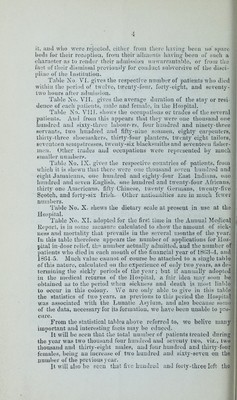
![Institution relieved ; one hundred and eixty-three not relieved , one thousand three hundred and eig’hteen cured ; and two hundred and forty-six dead. Of the two thousand and thirty eight male ]>atients one liLindred and seventy-four died, being a death-rate of 8.63 jier cent. Of the four liundred and thirty-four females, seventy-two died, being- a death-rate of 1G.5B per cent. Of the males and females united, tiie death rate was 9,95 per cent, being- a d(*creaw^e of 0.34 per cent, on the rate of mortality in the preceding year. The average dail}' number of patients was 180,43, and the average residence of patients in the Hospital was, for the males 20,43 days, and for the females 29.70 days. By careful perusal of the figures and tables above (pioted, it will be seen that whilst in this year the number of patients is the largest that has ever yet appeared in the Hospital returns, the rate per cent, of mortality is less than it has ever yet been The following- statistics for tlie last three years (being- the period of the complete separation of the Hospital from the Lunatic Asylum) proves this most conclusively : YEAR. ! Number of Patients Per centage of Death Treated. Kate. 18G2-3 18G3-4 18G4-5 1830 2205 2472 11 85 10.29 9.95 It will thus be seen that of the last three years in the one just terminated, the large.st number of patients was treated with the smallest per centage of mortality. In recent reports to the House of AssembI}', it has been repre- sented that the physical condition of the class of patients admitted into the Hospital has been gradually getting worse and worse. If this is the case, we might naturally have expected an increased mor- tality this year, considering the suffering caused by the late con. tinned drought ; the incidents arising- from the American war ; the wide-spread epidemic of small-pox and its se(|[uel(e; and the decided prevalence of an epidemic of bowel complaint. But it is a source of pleasure to the present medical officers to find that while the number treated is greater than has ever yet ajipeared, the mortality per cent, of the Hospital is less this year than it has ever yet been in the annals of the Institution. Altliough wo might favorably to ourselves do so, we will not compare its rate of mortality wiih that of Hospitals ill Great Britain, for reasons which will be self-evi- dent on further perusal of this report. We will not either compare its statistics wiih those of other Colonial Hospitals, as we are unac- quainted with the class of patients therein treated, and arc in ig- norance of the rules regulating their admii^sion. By reference to the annexed tables it will be seen that the fol- lowing diseases constitute the principal items in the catalogue of](https://iiif.wellcomecollection.org/image/b22337775_0007.jp2/full/800%2C/0/default.jpg)