Volume 1
Pseudo-relapses in cases of malarial fever during continuous quinine treatment / by Sir Ronald Ross and David Thomson.
- Ronald Ross
- Date:
- 1911
Licence: Public Domain Mark
Credit: Pseudo-relapses in cases of malarial fever during continuous quinine treatment / by Sir Ronald Ross and David Thomson. Source: Wellcome Collection.
3/8 page 409
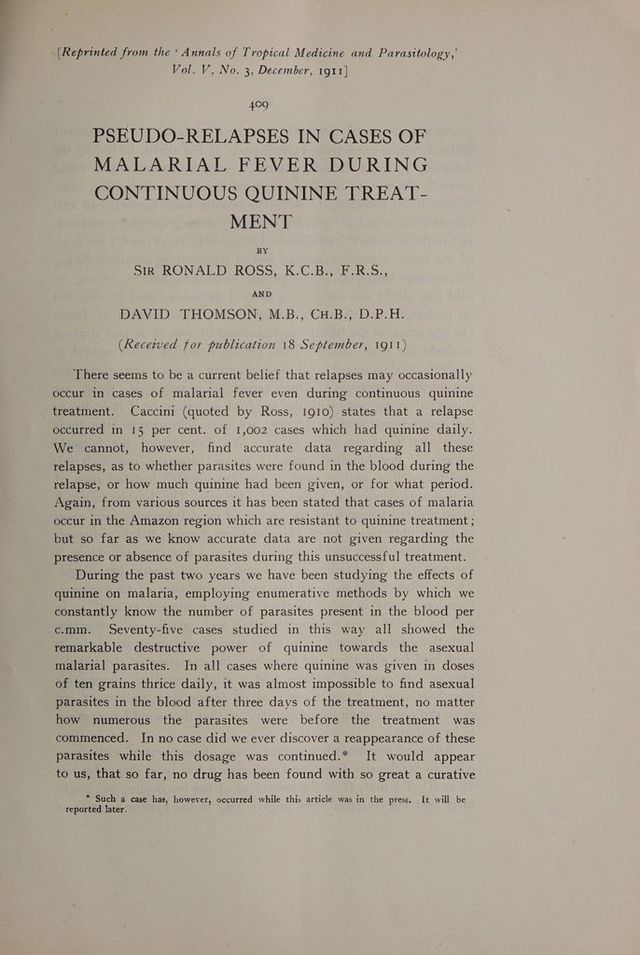
![[Reprinted from the ‘Annals of Tropical Medicine and Parasitology, Vol. V, No. 3, December, 1911] 409 PSEUDO-RELAPSES IN CASES OF MALARIAL FEVER DURING CONTINUOUS QUININE TREAT- MENT BY mine) NAIL ROoo, KC Babe ., AND VAVIDe THOMSON; M.B:, CHB D-P.H: (Recezved for publication 18 September, 1911) There seems to be a current belief that relapses may occasionally -occur in cases of malarial fever even during continuous quinine treatment. Caccini (quoted by Ross, 1910) states that a relapse occurred in 15 per cent. of 1,002 cases which had quinine daily. We cannot, however, find accurate data regarding all these relapses, as to whether parasites were found in the blood during the relapse, or how much quinine had been given, or for what period. Again, from various sources it has been stated that cases of malaria occur in the Amazon region which are resistant to quinine treatment ; but so far as we know accurate data are not given regarding the presence or absence of parasites during this unsuccessful treatment. During the past two years we have been studying the effects of quinine on malaria, employing enumerative methods by which we constantly know the number of parasites present in the blood per c.mm. Seventy-five cases studied in this way all showed the remarkable destructive power of quinine towards the asexual malarial parasites. In all cases where quinine was given in doses of ten grains thrice daily, it was almost impossible to find asexual parasites in the blood after three days of the treatment, no matter how numerous the parasites were before the treatment was commenced. In no case did we ever discover a reappearance of these parasites while this dosage was continued.* It would appear to us, that so far, no drug has been found with so great a curative * Such a case has, however, occurred while this article was in the press. It will be reported later.](https://iiif.wellcomecollection.org/image/b33444997_0001_0003.jp2/full/800%2C/0/default.jpg)