Transactions of the American Ophthalmological Society, Eighth Annual Meeting, Newport, July, 1871.
- American Ophthalmological Society
- Date:
- 1871
Licence: Public Domain Mark
Credit: Transactions of the American Ophthalmological Society, Eighth Annual Meeting, Newport, July, 1871. Source: Wellcome Collection.
Provider: This material has been provided by The Royal College of Surgeons of England. The original may be consulted at The Royal College of Surgeons of England.
143/146 page 141
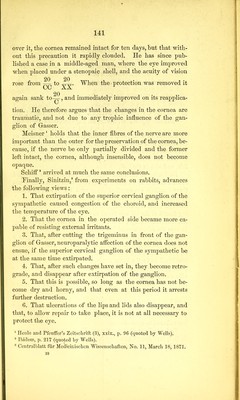
![over it, the cornea remained intact for ten days, but that with- out this precaution it rapidly clouded. He has since pub- lished a case in a middle-aged man, where the eye improved when placed under a stenopaic shell, and the acuity of vision rose from 20 XX* When the-protection was removed it 20 . . . again sank to-^, and immediately improved on its reapplica- tion. He therefore argues that the changes in the cornea are traumatic, and not due to any trophic influence of the gan- glion of Gasser. Meisner ^ holds that the inner flbres of the nerve are more important than the outer for the preservation of the cornea, be- cause, if the nerve be only partially divided and the former left intact, the cornea, although insensible, does not become opaque. Schifi* arrived at much the same conclusions. Finally, Sinitzin/ from experiments on rabbits, advances the following views: 1. That extirpation of the superior cervical ganglion of the sympathetic caused congestion of the choroid, and increased the temperature of the eye. 2. That the cornea in the operated side became more ca- pable of resisting external irritants. 3. That, after cutting the trigeminus in front of the gan- glion of Gasser, neuroparalytic affection of the cornea does not ensue, if the superior cervical ganglion of the sympathetic be at the same time extirpated. 4. That, after such changes have set in, they become retro- grade, and disappear after extirpation of the ganglion. 5. That this is possible, so long as the cornea has not be- come dry and horny, and that even at this period it arrests further destruction. 6. That ulcerations of the lips and lids also disappear, and that, to allow repair to take place, it is not at all necessary to protect the eye. ‘ Ilenle and Pfenffer’s Zeitsclirift (3), xxix., p. 96 (quoted by Wells). ^ Ibidem, p. 217 (quoted by Wells). ® Centralblatt fiir Mediciniscben Wisseiiscliaften, ]?Io. 11, March 18, 1871. 10](https://iiif.wellcomecollection.org/image/b22449887_0145.jp2/full/800%2C/0/default.jpg)