The Stowe catalogue priced and annotated / by Henry Rumsey Forster. [With 'Historical notice of Stowe', etc].
- Richard Temple-Nugent-Brydges-Chandos-Grenville, 2nd Duke of Buckingham and Chandos
- Date:
- 1848
Licence: Public Domain Mark
Credit: The Stowe catalogue priced and annotated / by Henry Rumsey Forster. [With 'Historical notice of Stowe', etc]. Source: Wellcome Collection.
382/398 page 300
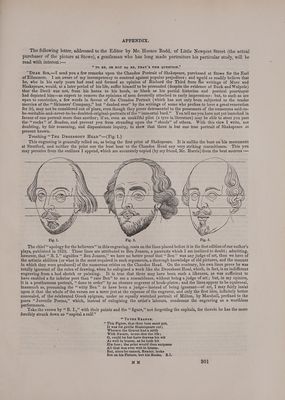
![engraving before the first folio, or the Gerard Johnson bust on the Stratford monument, than Raeburn’s Sir Walter Scott is unlike Sir Thomas Lawrence’s ;—or West’s Lord Byron unlike the better known portrait by Phillips. It has evi- dently been touched upon: the yellow oval that surrounds it has a look of Kneller’s age.” After the purchase of the picture for the Earl of Ellesmere, Mr. John Payne Collier, whose authority in all matters connected with Shakspearian literature is universally acknowledged, read the following paper, descriptive of the history and claims of the Portrait, at a meeting of the members of the Shakspeare Society, before whom it was exhibited by permission of its noble owner :— “This picture has for many years been known as ‘ The Chandos Portrait of Shakespeare.’ It came into possession of the family of the Duke of Buckingham from Mr. Nicoll, of Minchendon House, Southgate, whose daughter married the Duke of Chandos, who was father of Anna Eliza, Duchess of Buckingham. ‘Tt is presumed to have been the work of Richard Burbadge, the actor, who originally represented most of the great tragic parts in Shakespeare’s plays. Burbadge is known to have had considerable skill in painting; and left behind him, amongst other pictures, his own portrait, still preserved at Dulwich College. Those who compare the Chandos portrait of Shakespeare with the Dulwich portrait of Burbadge will not fail to remark proofs of similarity of style and treatment. ‘Joseph Taylor, the actor, who outlived Burbadge many years, is stated to have been the next owner of the picture, and it has been added that ‘he left it by will to Sir William Davenant;’ but as no will by Taylor has been discovered, and as he was very poor in the later period of his life, it seems much more probable that Davenant obtained it by purchase. “ There is no doubt that the picture once belonged to Davenant, who, having been born in 1605, died in 1668. If he never saw Shakespeare himself, he knew many who had lived in the greatest familiarity with him, and who must have been acquainted with every feature of his face, and with every turn of his expression. “Tt is quite certain also that Sir Godfrey Kneller made a copy of the portrait and gave it to Dryden; for Dryden states it in the verses he sent to the painter in return for the present. Dryden was thirty-seven years old when Davenant died, and must often have heard him speak of Shakespeare and of this portrait. “Thomas Betterton, who may be called the last performer of the school of Shakespeare, is said to have bought the picture at Davenant’s death: it was therefore Betterton’s property when Kneller copied it for Dryden, because Kneller did not visit England until 1674. Davenant would not have prized it, Betterton bought it, and Kneller copied it, if the resemblance to Shakespeare had not been accurate. Its resemblance to the engraving on the title-page of the first folio, which must have been selected by Heminge and Condell on account of the likeness, to which Ben Johnson bears direct testimony, is apparent. The only material differences are the. ear-ring, which was not inserted, and the dress, which in Martin Droeshout’s engraving is more ornamented and elaborate. “The copy make by Kneller for Dryden devolved into the hands of the Earl Fitzwilliam; and such’ was the esti- mation in which the original was held at later periods, that a painting was made from it by Sir Joshua Reynolds for Bishop Newton in 1760; an anonymous copy was presented by Capell to Trinity College, Cambridge, in 1768; and Malone engaged Ozias Humphrey to make a drawing of it in crayons in 1783, which is now in the collection of the Garrick Club. Ramberg and several artists employed by engravers also imitated it, but generally with little skill and less fidelity ; the enamel by the elder Bone is, however, a beautiful specimen of art. “The original passed from Betterton to Mrs. Barry the famous actress: she sold it to Mr. Robert Keck, of the Temple, for 40 guineas, and from him it came to Mr. Nicoll. It afterwards went, as already stated, to Stowe; and at the sale of the Duke of Buckingham’s effects, in September, 1848, it was bought by the Earl of Ellesmere for 355 guineas. Lord Chancellor Ellesmere was acquainted with Shakespeare, and by an appropriate coincidence, the present possessor of the title is also the possessor of the portrait. “It is painted on canvas, and is 22 inches high by 17 inches wide.” Upon this, the Atheneum has since had the following remarks :— “The only point of difference between Mr. Collier and ourselves on the subject of this famous portrait—is as to the person by whom it was painted. Mr. Collier is of opinion that it was painted by Richard Burbadge, who died in 1618-19; and our opinion was (as our readers will recollect) that it was a picture of the time of the Restoration (that is, 40 years later)—a copy made for Sir William Davenant from some known picture. Mr. Collier grounds his opinion chiefly, but not entirely, on an entry in Oldys’s Notes to Langbaine: which we shall copy entire. “Mr. Nicholas [Nicholl] of Southgate has a picture of Shakespeare which they say was painted by old Cornelius Jansen, others by Rich, Burbage the player. ‘‘Mr. Keck of the Temple gave Mrs. Barry 40 guineas for her Shakespeare—the same. “That Burbadge was a painter there is ample evidence to prove beyond his own portrait from his own hand in the Alleyn and Cartwright collection at Dulwich College; and it requires no great stretch of fancy to conceive that he painted at least one portrait of Shakespeare, wherever that portrait may be. There are many who concur with Mr. Collier in thinking the Chandos portrait the work of Burbadge—and we will go thus far with them, that we are willing to think it a copy from a portrait by Burbadge:—always remembering that when we use the word ‘copy,’ it is a copy made before 1668, and for a person so eminent as Sir William Davenant. That the picture now in the possession of the Earl of Ellesmere belonged to Sir William Davenant the poet, Betterton the actor, and Mrs. Barry the actress, is beyond the possibility of doubt. No one suspects for a single moment that the little Raphael in the Louvre did not belong to Henry VIII., or the busts at Hagley to the poet Pope. It is the fashion to doubt about Shakespeare. It is wonderful how much learning is wrapt up in a single shoulder-shrug of Antiquarian suspicion ! “Tt has not been hitherto observed in any recent description of this picture, that the head of Shakespeare prefixed to Rowe’s edition of Shakespeare, though a poor print in itself, was certainly made, and in Betterton’s lifetime, from this very Chandos portrait! Rowe derived from Betterton some curious particulars about Shakespeare:—and if he had been as inquisitive as Mr. Collier would have picked up many more.”](https://iiif.wellcomecollection.org/image/b3352242x_0382.jp2/full/800%2C/0/default.jpg)
 No text description is available for this image
 No text description is available for this image
 No text description is available for this image