The Stowe catalogue priced and annotated / by Henry Rumsey Forster. [With 'Historical notice of Stowe', etc].
- Richard Temple-Nugent-Brydges-Chandos-Grenville, 2nd Duke of Buckingham and Chandos
- Date:
- 1848
Licence: Public Domain Mark
Credit: The Stowe catalogue priced and annotated / by Henry Rumsey Forster. [With 'Historical notice of Stowe', etc]. Source: Wellcome Collection.
384/398 page 302
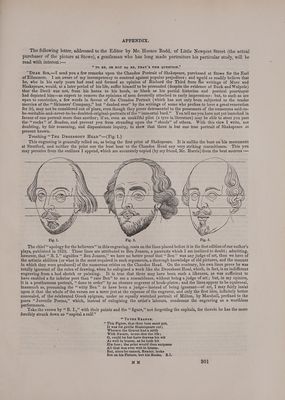
![Now, if this “hit his face” is not a joke—“ a palpable hit’’—I know not how to understand it; for anything more unlike “the human face divine” I can scarcely imagine. As for the “strife to out-doo nature,” it is absurd to believe that Ben Jonson could have written it in earnest. What strife could this ‘‘ poor’’ engraver have had with nature in executing this performance ?—a graver who would have passed, amongst the crowd of indifferent engravers, to the grave, had he not been fortunate enough to have been employed by the publishers of the first folio edition of Shakspeare’s Plays. Jonson then plainly tells us ‘not to looke on his picture, but his booke’’; he says the ‘ figure” was “cut for Shakspeare,”’ so it was, no doubt, and a bad “ figure’ it cuts! My firm conviction is, that it was intended as a likeness of the Poet, but that it was ‘“‘inade up” (possibly by Burbadge, who, i¢ is said, ‘was known to have had considerable skill in painting’), and that, from remembrance of the original, in some character which Shakspeare had appeared in upon the stage ; and that Jonson was either a wag or flatterer; and I therefore pronounce’the Droeshout head “Not TO BE” the “ vera effigies’’ of the Poet. THe Stratrorp Bust.—( Fig. 3.) A writer of some eminence has endeavoured to elevate this bust into importance, and it certainly claims priority of time and merit to the Droeshout print. Monuments are not erected in a day, and this bust must have been executed before the following lines, prefixed to the first edition of the Poet’s Works, were written by Leonard Digges :— ‘« Shake-speare, at length thy pious fellowes give ; The world thy works ; thy works by which out-live Thy Tombe, thy name must, when that stone is rent, And time dissolves thy Stratford monument. Here we alive shall view thee still,” &c. It appears that by using the words “at length,” that the “ Works’ were some time in hand, and that the monument must have been completed, and put up before the book was pub'ished. Taking this for granted, there is no doubt the model was made some years before the book was printed, consequently it brings the bust nearer to the time of Shakspeare’s death than the print. Again, as the inhabitants of Stratford and his relations must have been well acquainted with his person, figure, and face, it is not to be credited that they would have placed in a sacred edifice any representation totally devoid of truth. The monument, judging from the various prints and accounts of it extant, has been much altered, from time to time, at the whim and caprice of parties who did not esteem it so highly as did “ B. J.’”’? Droeshout’s engraving, and who sought to improve it. The variations in the positions of the two mourning boys have been numerous. The earliest engraving, by Hollar for Dugdale’s “ Warwickshire,” depicts the little fellows sittmg sideways on a marble slab, Vertue, who in general is to be relied upon for good drawing and accurate likenesses, was poetical in his engraving, as he has perched the boys on the top of the marble, as supporters to the arms; he has also turned up their torches and set light to them, and given the one an hour-glass, and the other a skull, | Another liberty he has taken tends strongly to shew his disbelicf in the faithfulness of the bust, and his confidence in the Chandos Head, which is, his having placed the head from the Chandos Picture on the shoulders of Gerard Johnson’s bust. Rowe, in his edition of 1709, has the two boys placed dos-a-dos, one of them is holding up a spade, the other an hour-glass. The vest of Shakspeare in this engraving is spotted like a leopard, and the arms thrust through a sleeveless surtout; the head is different from any other, and the hands are placed on a cushion. Boydell’s drawing, engraved by Neagle, is the most accurate, both as to the archi- tecture and detail, as well as for the correctness of the bust. I cannot account for the strange variety of representations of the tomb, from the days of Hollar to the present, except that the monument has been frequently restored. There are some temarkable additions, such as the good people letting the poet have pen and paper, in case of need, which he had not in the days of Dugdale and Rowe. The cast by Bullock is the best reference we have, and from that, although the beauty of the sculpture has entirely vanished, through the folly of Malone* and former meddlers painting it over, there is still spirit enough left for me to think it a fancy bust, possessing a general resemblance of the Bard in his later days; the contrast of the curls and the peaked beard, to the Droeshout print, is remarkable, and, although we have no history of its having been taken from life, we may presume that it was modelled from remembrance by a man who has displayed considerable talent, and it is therefore to be depended on, although “Nor To BB” fully depended upon as the vraisemblance of the Bard of Avon. Tue Cuanpos Heav.—(Fig. 2.) I fear that I shall have tired your patience before I get to the real subject of my letter. If you are resolved to proceed with me in my researches after truth, vou must commence with reading a few remarks made by the venerators of the Chandos Head, as a true portrait of Shakspeare. Malone says :—“TIt is painted by a very ordinary hand, having been at some subsequent period painted over, and being now (1784) in a state of decay.” Boaden says:—‘‘The Chandos canvas has not the smallest look of Jansen’s manner. He in general painted his heads upon board, and in truth was an artist only inferior to Vandyke;t whereas, the reader will have found the Chandos Picture to have been painted by an ordinary hand, but to possess unquestionable resemblance to the poet, and to have been very carefully transmitted through the hands of authentic possessors. ‘It seemed to Sir Joshua Reynolds to be an unfinished sketch.”|]. . . . ‘“ Forty years make great difference in pictures.” * “ Stranger, whoe’er thou art who views this stone, Invoke a poet’s curse upon Malone, Whose meddling touch his barbarous taste displays, And smears his tombstone as he marred his plays.” + “Painted over—and in a state of decay.” Both these assertions are untrue. There have been a few slight touches of re-paint where small holes have existed, and the beard, the hair, and buttons have had partial helps from some unskilful hand. It is not, however, painted Over, hor Is the picture decayed, the background being pure, and the damage entirely accruing through ignorance, and not age. ft The learned ‘ Inquirer” did not Know that there are more pictures by Jansen on canvas than on board, nor does he seem to have known that Jansen painted in cwo distinct styles; his eariier portraits, although finely drawn and beautifully coloured, have a hardness and stiffness in them which 1s very different from that of his later pictures, wherein he emulated Vandyke. Surely there is no authority that Sir Joshua ever so far committed himself,](https://iiif.wellcomecollection.org/image/b3352242x_0384.jp2/full/800%2C/0/default.jpg)
 No text description is available for this image
 No text description is available for this image
 No text description is available for this image