delta-d-bornylsemicarbazide and delta-d-neobornylsemicarbazide / by J.A. Goodson.
- Goodson, John Augustus.
- Date:
- [1927.]
Licence: Public Domain Mark
Credit: delta-d-bornylsemicarbazide and delta-d-neobornylsemicarbazide / by J.A. Goodson. Source: Wellcome Collection.
4/8 page 1998
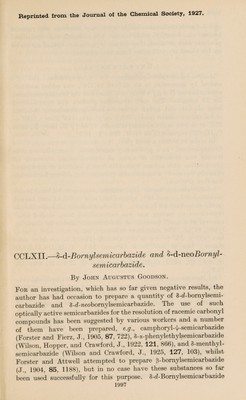
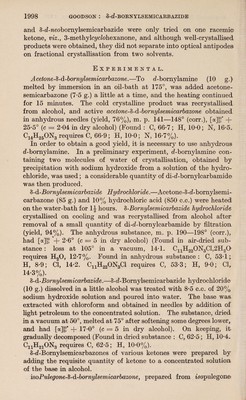
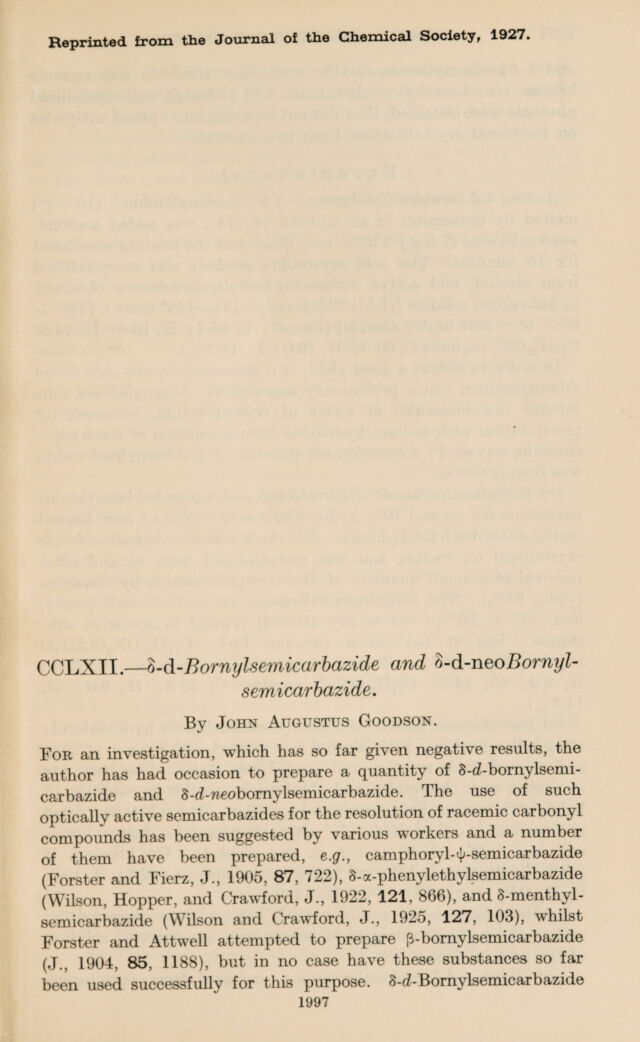
![and S-d-weobornylsemicarbazide were only tried on one racemic ketone, viz., 3-methylcycZohexanone, and although well-crystallised products were obtained, they did not separate into optical antipodes on fractional crystallisation from two solvents. Experimental. Acetone-^-d-bornylsemicarbazone.—To d-bornylamine (10 g.) melted by immersion in an oil-bath at 175°, was added acetone- semicarbazone (7-5 g.) a little at a time, and the heating continued for 15 minutes. The cold crystalline product was recrystallised from alcohol, and active acetone-^-d-bornylsemicarbazone obtained in anhydrous needles (yield, 76%), m. p. 141—148° (corr.), [a]^’ -f- 25*5° (c = 2-04 in dry alcohol) (Found : C, 66-7; H, 10*0; N, 16-5- C14H25ON3 requires C, 66-9; H, 10*0; N, 16*7%). In order to obtain a good yield, it is necessary to use anhydrous d-bornylamine. In a preliminary experiment, d-bornylamine con¬ taining two molecules of water of crystallisation, obtained by precipitation with sodium hydroxide from a solution of the hydro¬ chloride, was used; a considerable quantity of di-^-bornylcarbamide; was then produced. S-d-Bornylsemicarbazide Hydrochloride.—Acetone-S-d-bornylsemi- carbazone (85 g.) and 10% hydrochloric acid (850 c.c.) were heated on the water-bath for 1 \ hours. S-Bornylsemicarbazide hydrochloride crystallised on cooling and was recrystallised from alcohol after removal of a small quantity of di-d-bornylcarbamide by filtration (yield, 94%). The anhydrous substance, m. p. 190—198° (corr.), had [a]g +2-6° (c = 5 in dry alcohol) (Found in air-dried sub¬ stance : loss at 105° in a vacuum, 14-1. C11H220N3Cl,2H2O requires H20, 12*7%. Found in anhydrous substance: C, 53 T; H, 8-9; Cl, 14-2. CnH22ON3Cl requires C, 53-3; H, 9-0; Cl, 14-3%). §-&-Bornyisemicarbazide.—8-c£-Bornylsemicarbazide hydrochloride (10 g.) dissolved in a little alcohol was treated with 8*5 c.c. of 20% sodium hydroxide solution and poured into water. The base was extracted with chloroform and obtained in needles by addition of light petroleum to the concentrated solution. The substance, dried in a vacuum at 50°, melted at 75° after softening some degrees lower, and had [a]ff -f- 17-0° (c = 5 in dry alcohol). On keeping, it gradually decomposed (Found in dried substance : C, 62-5; H, 10-4. CnH2iON3 requires C, 62-5; H, 10*0%). 8-cZ-Bornylsemicarbazones of various ketones were prepared hy adding the requisite quantity of ketone to a concentrated solution of the base in alcohol. isoPidegone-$-&-bornylsemicarbazone, prepared from isopulegone](https://iiif.wellcomecollection.org/image/b30626766_0004.jp2/full/800%2C/0/default.jpg)



 No text description is available for this image
 No text description is available for this image
 No text description is available for this image