A critical summary of the evidence before the Royal Commission upon the Contagious Diseases Acts, 1866-1869 / prepared for the National Association for the Repeal of the Contagious Diseases Acts, by Douglas Kingsford.
- Kingsford, D. P. W. (Douglas P. W.)
- Date:
- [1869]
Licence: Public Domain Mark
Credit: A critical summary of the evidence before the Royal Commission upon the Contagious Diseases Acts, 1866-1869 / prepared for the National Association for the Repeal of the Contagious Diseases Acts, by Douglas Kingsford. Source: Wellcome Collection.
Provider: This material has been provided by The Royal College of Surgeons of England. The original may be consulted at The Royal College of Surgeons of England.
112/130 (page 6)
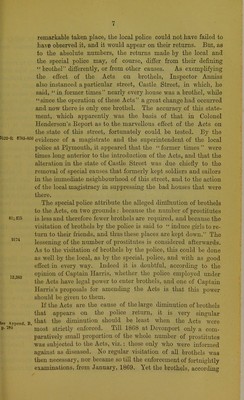
![413 728-32 1865 and 1868 than afterwards. We show below that the numbers of prostitutes in this district for the above years were gi-ossly exaggerated by including large numbers of women, suspected, but not ascertained, to be prostitutes. This fact ex- plains a similar exaggeration in the numbers of brothels. From 1865 to 1868, Lispector Anniss took as a brothel every house occupied or resorted to by women suspected by him to be prosti- tutes, the number of whom was gradually decreasing as these suspicions were tested by inquiry in the course of the partial re- gistration that took place in these years. At the end of 1868, registration of j)rostitutes was complete, preparatory to the commencement of the fortnightly examinations in January, 1869. Accordingly for 1869 and 1870, Insirector Anniss took to be brothels, houses occupied or resorted to by registti-ed prostitutes. It is evident too that in the visits during which these retmns were made, the inspector could not have had full time and opportunity for the necessary observation and accm-ate inquu-y. With respect to houses, not inhabited by prostitutes, though used by them as occasional resorts, the inspector could not by a visit in the day-time have obtained grounds for deciding on the character of the house. It was to a great extent mere guess-work, with a bias on his part to caU every house a brothel, as to which he felt any doubt or suspicion. When, however, a registration of prostitutes was carried;] out, greater caution became necessaiy, and then on the statement of Superintendent Wakeford, “ the police took steps to ascertain by whom the house was kept, the character of the- person keeping it, and the arrangements of the house, before] they would decide whether it was a brothel or not.” The local police make annual returns of the number ofj brothels, which are printed in the Judicial Statistics. According! to these returns the number of brothels was :— 1863 1864 1865 1866 1867 1868 1869 1870M Devonport 39 30 40 46 38 80 32 89 ^ Plymouth 115 100 90 75 86 75 64 154 130 180 121 124 105 96 186 ) ! We cite these returns only to show, from the relative numbers,; the extreme improbability that Inspector Anniss’s returns are accurate in showing a decrease in the number of brothels^ between 1865 and 1869, from 366 to 181; for, had a decrease so](https://iiif.wellcomecollection.org/image/b22411744_0114.jp2/full/800%2C/0/default.jpg)