Five thousand receipts in all the useful and domestic arts / [Colin Mackenzie].
- Colin Mackenzie
- Date:
- 1823
Licence: Public Domain Mark
Credit: Five thousand receipts in all the useful and domestic arts / [Colin Mackenzie]. Source: Wellcome Collection.
29/834 page 25
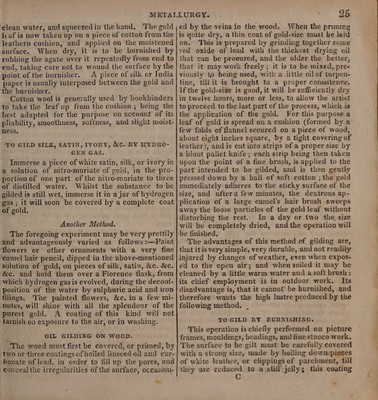
![‘clean water, and squeezed in the hand, The gold deaf is now taken up on a piece of cotton from the leathern cushion, and applied on the moistened surface. When dry, it is to be burnished by rubbing the agate over it repeatedly from end to end, taking care not to wound the surface by the point of the burnisher. A piece of silk or India paper is usually interposed between the gold and the burnisier. Cotton wool is generally used by bookbinders to take the leaf up from the cushion ; being the best adapted for the purpose on account of its pliability, smoothness, softness, and slight moist- ness. “TO GILD SILK, SATIN, IVORY, &c. BY HYDRO- GEN GAS. Immerse a piece of white satin, silk, or ivory in a solution of nitro-muriate of gold, in the pro- portion of one part of the nitre-muriate to three of distilled water. Whilst the substance to be gilded is still wet, immerse it in a jar of hydrogen gas ; it will soon be covered by a complete coat of gold. Another Method. _ The foregoing experiment may be very prettily ‘and advantageously varied as follows :—Paint flowers or other ornaments with a very fine ‘camel hair pencil, dipped in the above-mentioned solution of gold, on pieces of silk, satin, &c. &c. ‘&c. and hold them over a Florence flask, from ~which hydrogen gas is evolved, during the decont- ‘position of the water by sulphuric acid and iron filings. The painted flowers, &c. in a few mi- ‘Dutes, will shine with all the splendour of the ‘purest gold. A coating of this kind will not tarnish on exposure to the air, or in washing. ; OIL GILDING ON WOOD. - The wood must first be covered, or primed, by two orthree coatings of boiled linseed oi] and car- bonate of Jead, in order to fillup the pores, and e ed by the veins in the wood. When the pnming is quite dry, a thin coat of gold-size must be laid on, This is prepared by grinding together some red oxide of lead with the thickest drying oil that can be proeured, and the older the better, that it may work freely; it is to be mixed, pre- viously to being used, with a little oil of turpen- tine, tiliit is brought to a proper consistence. If the gold-size is good, it will be sufficiently dry in twelve hours, more or less, to allow the artist to proceed to the last part of the process, which is the application of the gold. For this purpose a leaf of gold is spread on a cushion (formed by a few folds of flannel secured on a piece of wood, about eight inches square, by a tight covering of leather), and is cut into strips of a proper size by a biunt pallet knife; each strip being then taken upon the point of a fine brush, is applied to the part intended to be gilded, and is then gently pressed down by a bail of soft cotton ; the gold immediately adheres to the sticky surface of the size, and aftera few minutes, the dextrous ap- plication of a large camel’s hair brush sweeps disturbing the rest. In a day or two the: size will be completely dried, and the operation will be finished. The advantages of this method of gilding are, that it is very simple, very durable, and not readily injured by changes of weather, even when expos- ed to the open air; and when soiled it may be cleaned by a little warm water and a soft brush: its chief employment is in outdoor work. Its disadvantage is, that it cannot’ be burnished, and therefore wauts the high lustre produced by the following method. _ TO GILD BY BURNISHING.. This operation is chiefly performed on pictare frames, mouldings, beadings, and fine stucco work. The surface to be gilt must be carefully covered with a strong size, made by boiling down»pieces of white leather, or clippings of parchment, till they are ieee to a stiff jelly; this coating *](https://iiif.wellcomecollection.org/image/b22024487_0029.jp2/full/800%2C/0/default.jpg)



 No text description is available for this image
 No text description is available for this image
 No text description is available for this image