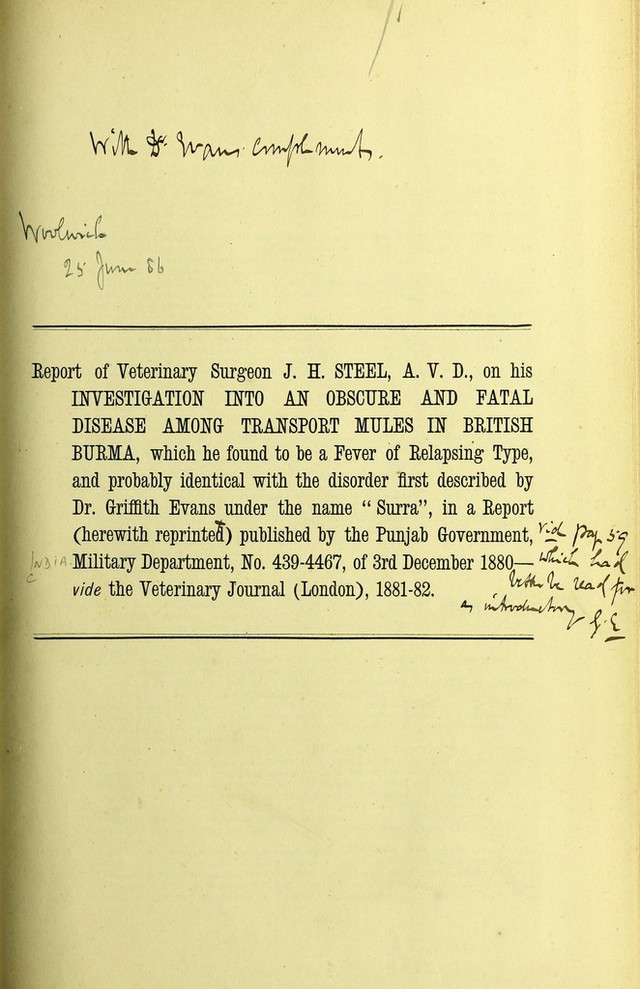
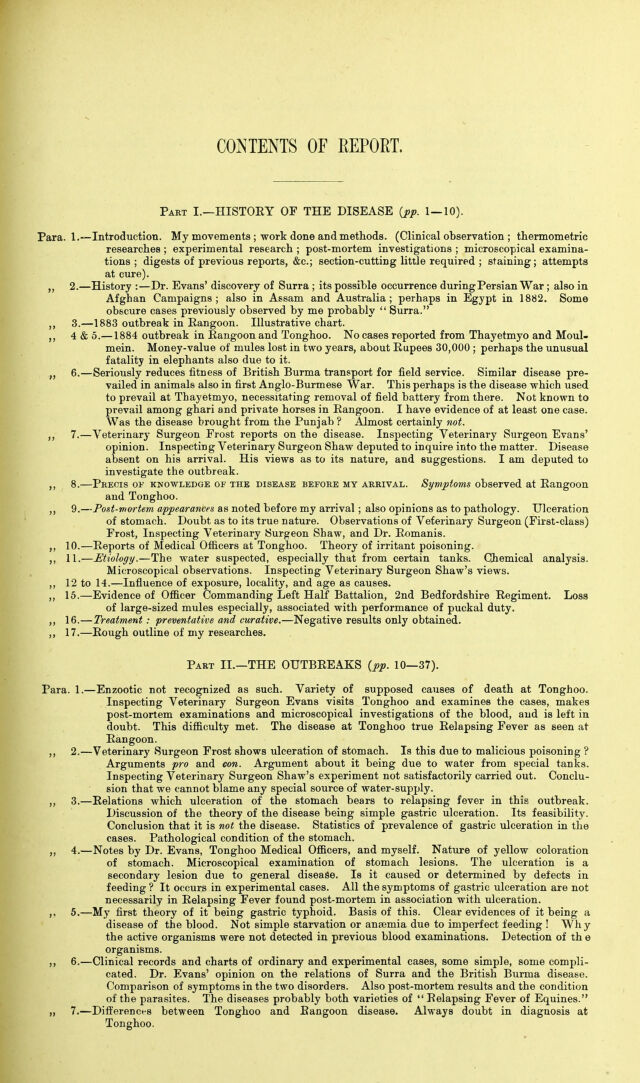
Report of veterinary surgeon J. H. Steel, A. V. D., on his investigation into an obscure and fatal disease among transport mules in British Burma, which he found to be a fever of relapsing type, and probably identical with the disorder first described by Dr. Griffith Evans under the name "Surra", in a report (herewith reprinted) published by the Punjab Government, Military Department, No. 439-4467, of 3rd. December 1880-vide the Veterinary Journal (London), 1881-1882 / [By Steel, J. H.].
- Steel, John Henry
- Date:
- 1886
Licence: Public Domain Mark
Credit: Report of veterinary surgeon J. H. Steel, A. V. D., on his investigation into an obscure and fatal disease among transport mules in British Burma, which he found to be a fever of relapsing type, and probably identical with the disorder first described by Dr. Griffith Evans under the name "Surra", in a report (herewith reprinted) published by the Punjab Government, Military Department, No. 439-4467, of 3rd. December 1880-vide the Veterinary Journal (London), 1881-1882 / [By Steel, J. H.]. Source: Wellcome Collection.
Provider: This material has been provided by Royal College of Physicians, London. The original may be consulted at Royal College of Physicians, London.
11/92 page 3
![and November, less so in December and January, and two cases succumbed to it at the end of February, when the outbreak ceased. Of the Native Infantry half transport, four mules (one hired out to an officer), and of the European Infantry, two mules died of the enzootic this season (1883-84j. The probable losses from relapsing fever of Government transport animals at Rangoon during the year 1883-84 may be tabulated as follows:— Corps, &c. Mules. Ponies. Eemarks. Transport Supply Depot Madras Native Infantry European Infantry .. ., Queen's Own Sappers and Miners .. 42 4 5 11 Number of cases among ponies perhaps exaggerated. Inclusive of one mule hired out to an officer. One recorded as ulceration of stomach; four doubtful. There have been no fatalities among these from doubtful causes. Total .. 51 11 62 animals at Rs. 150 each; total approximate value Es. 9,300. Two cases seem to have occurred this season at Tonghoo ; one in August and one in January in the European and Native Infantry regiments respectively. This outbreak was at an end when Inspecting Veterinary Surgeon Shaw arrived to investigate it (19th April 1884). 4. In the current season the disease re-appeared, or rather again began to assume importance, for it cannot be said to have ever quite died out. Strange to say, this time it proved most severe in those lines in which it had previously been least preva- lent. This is a noteworthy fact. Is it to be attributed to last year's outbreak having thoroughly weeded the depot of animals capable of taking the disease or to the efficacy of measures of prevention and improved hygiene adopted ? In so far as I can learn, the only change made in the latter respect was as concerns the water-supply, certain suspected tanks being carefully avoided, and we shall see that the evidence against those tanks is not strong. But it may be that the remaining depot mules have not this year been exposed to the climatic conditions necessary to generate this disorder; they were not, as in 1883-84, exposed during the monsoon time, which is a very likely cause of the disease. Still we must not neglect this important evidence in support of the view of Veterinary Surgeon (First-class) Frost that the disease in 1883-84 was conveyed by the water. The supply of drinking water was altered as to its source in accordance with his suggestions, and there has been no outbreak in the dep6t this year, although sporadic cases have occurred there. 5. The brunt of this year's outbreak has, at Rangoon, fallen on the 2nd Somer- setshire Transport Lines : a doubtful case occurred in March; two deaths are recorded for May; in September twelve were fatal; in October the maximum (nineteen) was reached ; twelve died in November and six in December; four succumbed in January 1885 and two in February. I left one affected animal alive on my departure from Rangoon. In all I had about twenty fatal cases at Rangoon (experimental inclusive). I missed a few opportunities of post-mortem examinations by absence at outstations. That the disease is due to the water of special tanks only is disproved by its prevalence at Tonghoo this year. I have absolute proof, from personal investigations, that the disease which has recently caused so many deaths there is the same as that of Rangoon, but of more acute character and even more fatal. My returns show that up to their date, i.e., 25th December 1884, some fifty mules of the 2nd Bedfordshire half transport had died in the current official year, the majority probably from relapsing fever; of the 3id Palamcottah Light Infantry, about fifty-four mules died during the same period. The supposed causes of death in these cases, as given in the returns and also in the post- mortem examination committee reports, lead me to believe that I may fairly attribute at least 100 out of these 104 deaths in Tonghoo to the enzootic of which I am treating. Since the returns were sent in, more deaths have taken place [to the end of February 1885 : eight among the mules of European Infantry, seven in Native Infantry, vide Telegram Transport 152, dated Rangoon, 17th March 1885]. No cases of this disease have been reported from Moulmein nor from Thayetmyo during these two years ; on the contrary there are slight grounds for the belief that some affected animals recov- ered after arrival at Thayetmyo. Some fatalities occurred on line of march. We](https://iiif.wellcomecollection.org/image/b24749278_0013.jp2/full/800%2C/0/default.jpg)