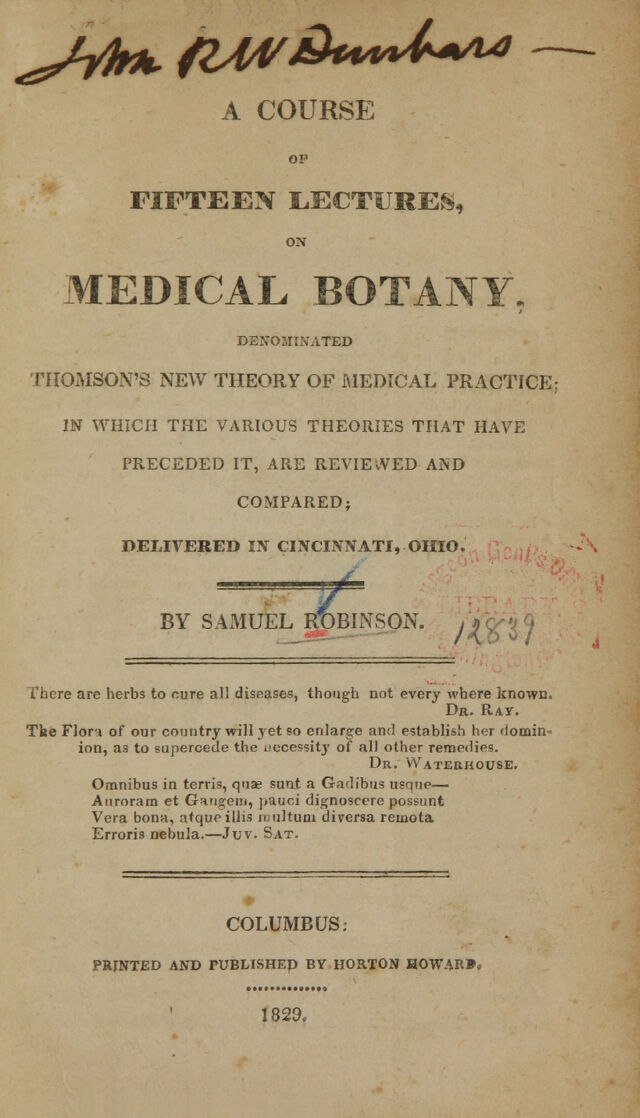
A course of fifteen lectures, on medical botany : denominated Thomson's theory of medical practice; in which the various theories that have preceded it, are reviewed and compared; delivered in Cincinnati, Ohio.
- Robinson, Samuel
- Date:
- 1829
Licence: Public Domain Mark
Credit: A course of fifteen lectures, on medical botany : denominated Thomson's theory of medical practice; in which the various theories that have preceded it, are reviewed and compared; delivered in Cincinnati, Ohio. Source: Wellcome Collection.
Provider: This material has been provided by the National Library of Medicine (U.S.), through the Medical Heritage Library. The original may be consulted at the National Library of Medicine (U.S.)
13/206
![perior minds do most delight to travel—the untried, stormy journey of perilous adventure—according to the saying of that modern sage, Dr. Johnson, The man that can sub- mit to trwige behind, was never made to walk before. Beyo >d all this, we are presented v. ith solemn facts from history, to shew us that, perhaps, the learned are as much indebted to the illiterate, for their observations, as the latter to the former for their science. They are equally necessary to each other, in forming the sum of human things from The poor Indian whose untutored nunc], Sees God in clouds, and hears huu in the wind to the soaring spirit of the philosopher, traversing the starry sky. In vain do enlightened nations boast, that they have gathered within themselves all the arts and sciences. The carta iscov red over with vegetables and animals, the sim- ple vocabulary of which, no scholar, no academy, no nation whatever, will ever be able perfectly to acquire. No nor all the human race, in their united wisdom, shall be ever able to find out the limits, the name and nature of herinnu- nerabl millions! We, therefore, with all humility, in consideration of our profound ignorance, should be willing to glean from every source, which promises an accession to the stock oi our materials. And it is to savages,—to men utterly unknown,—that we are indebted for the first observations which are the sou ices of all science. It was neither to the witty and the pulished Greeks, nor the grave and stalely Romans,—but to nations which we denominate barbarous, that we are indebted for the use of simples, of bread, of wine, of domestic animals, of cloths, of dyes for cloths,of metals; and for every thing most useful and most agreeable <ov human life. Modern Europe may glory in her liscoveries; buJ the Art of Print- ing, which ou^iit to immortalize the inventor, has beea](https://iiif.wellcomecollection.org/image/b21150746_0013.jp2/full/800%2C/0/default.jpg)