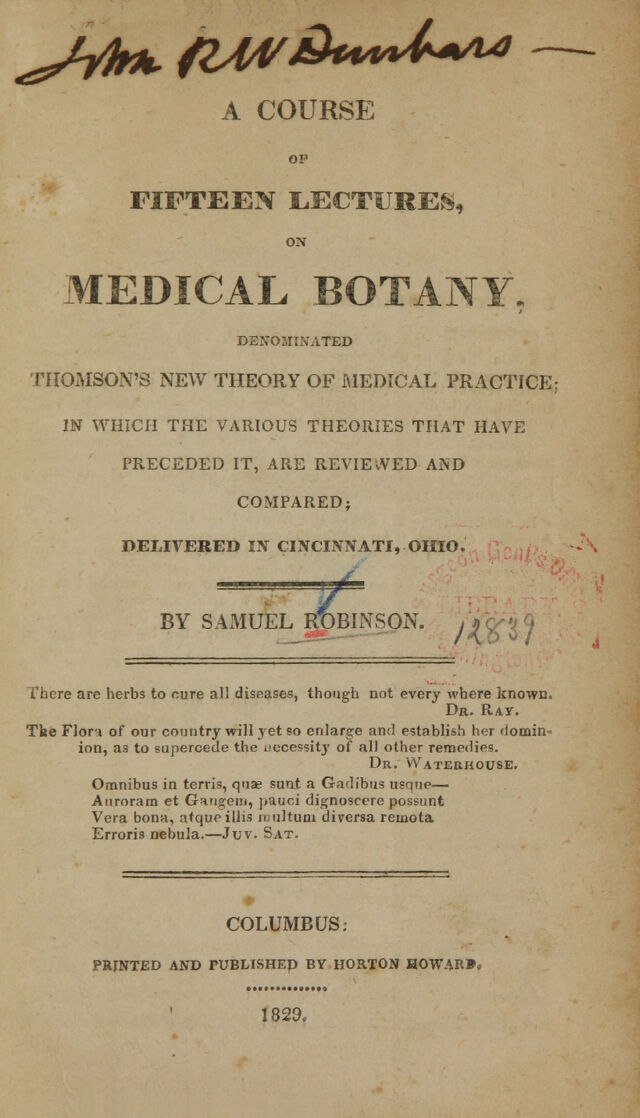
A course of fifteen lectures, on medical botany : denominated Thomson's theory of medical practice; in which the various theories that have preceded it, are reviewed and compared; delivered in Cincinnati, Ohio.
- Robinson, Samuel
- Date:
- 1829
Licence: Public Domain Mark
Credit: A course of fifteen lectures, on medical botany : denominated Thomson's theory of medical practice; in which the various theories that have preceded it, are reviewed and compared; delivered in Cincinnati, Ohio. Source: Wellcome Collection.
Provider: This material has been provided by the National Library of Medicine (U.S.), through the Medical Heritage Library. The original may be consulted at the National Library of Medicine (U.S.)
31/206
![20 his decisions in medicine were received like the oracles of Apollo; not oiilj with confidence but with veneration. The improvement of medicine, at this period, depended on two classes of philosophers, unknown to each other; the Sophoi—the students of natural philosophy, who compre- hended the human body as a part of their science—and the Asclepiadas—who stud ed the history and cures of dis- ease; the descendants and disciples cf Esculapius. The former examined the functions of the human body, accord- ing to the laws of their own science; while the latter pre- scribed for diseases, according to fixed rules,established and confirmed by numerous cures and experiments. The phi- losophers reasoned—the Asclepiadae acta'. Hippocrates, educated in the art of phjsic, found at once the vast advantage that would be gained, by obtaining the knowledge of philosophy, and thus enrich medicine by a union of both sciences. He applied himself with the ut- most vigor and industry to philosophy—to penetrate the essences of bodies—and endeavored to ascend to the constit- uent principles and powers of the universe. Ke thus conceived one of those grand and original ideas, which serves as a new era, in the history of genius. This was to enlighten experience by reasoning, and to rectify the- ory by practice. In his theory, however, he only admitted principles which may explain the phenomena observable in the human body, considered with respect to sickness or health. Improved and exalted by.this new method, the sci- ence of physic made a more sure and certain progress in the path opened before it. Hippocrates silently effected a revolution, which has changed the face of Medicine, and caused it to rank with the sublimest parts of human science. It would be equally useless and prolix, to enlarge on the happy experiments he made, of the new remedies he dis- covered, or the prodigies he wrought, in all the places hon- [3*]](https://iiif.wellcomecollection.org/image/b21150746_0031.jp2/full/800%2C/0/default.jpg)