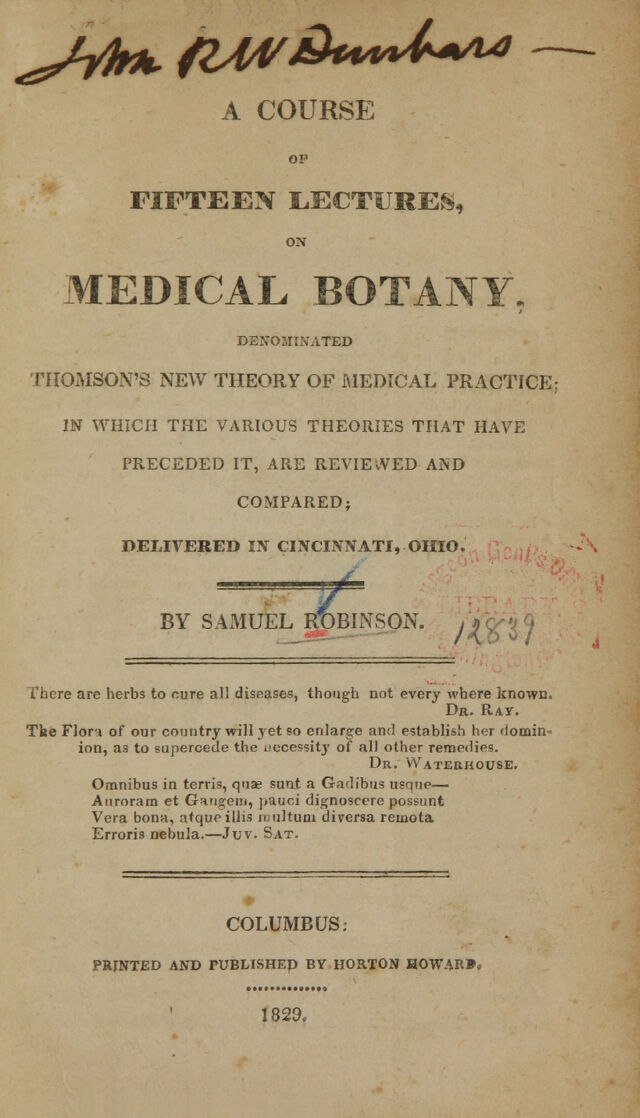
A course of fifteen lectures, on medical botany : denominated Thomson's theory of medical practice; in which the various theories that have preceded it, are reviewed and compared; delivered in Cincinnati, Ohio.
- Robinson, Samuel
- Date:
- 1829
Licence: Public Domain Mark
Credit: A course of fifteen lectures, on medical botany : denominated Thomson's theory of medical practice; in which the various theories that have preceded it, are reviewed and compared; delivered in Cincinnati, Ohio. Source: Wellcome Collection.
Provider: This material has been provided by the National Library of Medicine (U.S.), through the Medical Heritage Library. The original may be consulted at the National Library of Medicine (U.S.)
50/206
![nervous system, there isa series of three conditions: 1st, an im • ression made on the organ of sense, or sentient part; 2d, in ro;i>equei.ee o( this, there is a perception created in the common origin of sense, sensoriunt commune; 3d, there is a motion or contraction excited in the moving fihres, which depend unon the nerves. We call these from Gai> bius, impression, perception, irritation. All phenomena are comprehended under these thn c. Of these three condi- tions, the intermediate link- is perception, and on it the other two depend. This link, perception, is the foundation of all our internal operations; being derived from the immaterial power within us, and connected with our materia] part. This immaterial power may he left out in medicine; for if c Kit act n e'cessi ily follows pe ception, and perception as necessarily follows impression, we have no more occasion to take notice of it as a sentient principle, than if it were a mechanical cause. The doctor, how< ver, shews that impres- sio i may excite irritation, and often does, without the in- tervention of perception; and shows the absurdity of Stahl and hi- followers, by asserting that the soul is conscious of every impression. There are, says the doctor, a variety of impressions, which are not at all attended to by perception- or if we perceive, it is the effects, and not the impressions themselves. As to perception,it always depends on impres- sion; so that the old saying is very true—*nil in intelleclu quod non Jicit prius in sensuf These impressions are vari- ed by the sensorium commune, or origin of the nerves. Irrita. tion depends constantly on perception or impression. This system so carefully arranged, and the investigation of the nervous system conducted and investigated by him with a success which has no parallel, has nevertheless been denounced uncertain, incomprehensible, and disasterous. He has been charged with overlooking, or but slightly glan- cing, at the pathology of the bloodvessels, in his concentrat- ed views of the nervous system. And by adopting the no,](https://iiif.wellcomecollection.org/image/b21150746_0050.jp2/full/800%2C/0/default.jpg)