The Strand Magazine : an illustrated monthly. Vol. 1, no. 2, February 1891 / edited by George Newnes.
- Date:
- 1891
Licence: Public Domain Mark
Credit: The Strand Magazine : an illustrated monthly. Vol. 1, no. 2, February 1891 / edited by George Newnes. Source: Wellcome Collection.
120/140 (page 210)
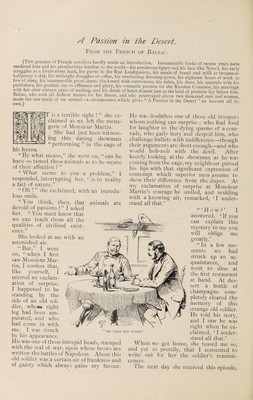
![/ A Passion in the Desert. j From the French of Balzac. [The greatest of French novelists_hardly needs an introduction. Innumerable books of recent years have rendered him and his peculiarities familiar to the world—his ponderous figure and his face like Nero^s his early struggles as a Grub-street hack, his garret in the Rue Lesdiguieres, his meals of bread and milk at twopence- halfpenny a day, his midnight draughts of coffee, his everlasting dressing-gown, his eighteen hours of work to hve 01 sleep, his innumerable proof-sheets blackened with corrections, his debts, his duns, his quarrels with his gradual lise to affluence and glory, his romantic passion for the Russian Countess, his marriage with her after sixteen yejiis of waiting, and his death of heart disease just as the land of promise lay before him. Ralzacq who took all human nature for his theme, and who pourtrayed above tw'o thousand men and w'omen made but one study of an animal—a circumstance W'hich gives “ A Passion in the Desert ” an interest all its own.] T is a terrible sight ! ” she ex¬ claimed as we left the mena¬ gerie of Monsieur Martin. She had just been witness¬ ing this daring showman “ performing ” in the cage of his hyena. “By what means,” she went on, “can he have so tamed these animals as to be secure of their affection ? ” “What seems to you a problem,” I responded, interrupting her, “ is in reality a fact of nature.” “ Oh ! ” she exclaimed, with an incredu¬ lous smile. “ You think, then, that animals are devoid of passions ?” I asked her. “You must know that we can teach them all the qualities of civilised exist¬ ence.” She looked at me with an astonished air. “ But,” I went on, “ when I first saw Monsieur Mar¬ tin, I confess that, like yourself, I uttered an exclam¬ ation of surprise. I happened to be standing by the side of an old sol¬ dier, who»« right leg had been am¬ putated, and who had come in with me. I was struck by his appearance. His was one of those intrepid heads, stamped with the seal of war, upon whose brows are written the battles of Napoleon. About this old soldier was a certain air of frankness and of gaiety which always gains my favour. He was doubtless one of those old troopers Avhom nothing can surprise ; who find food for laughter in the dying spasms of a com¬ rade, who gaily bury and despoil him, who challenge bullets with indifference—though their arguments are short enough,—and who would hob-nob with the devil. After keenly looking at the showman as he was coming from the cage, my neighbour pursed his lips with that significant expression of contempt which superior men assume to show their difference from the dupes. At my exclamation of surprise at Monsieur Martin’s courage he smiled, and nodding with a knowing air, remarked, ^ I under¬ stand all that.’ “‘How?’ I answered. ‘ If you can explain this mystery to me you will oblige me greatly.’ “In a few mo¬ ments we had struck up an ac¬ quaintance, and went to dine at the first restaurant at hand. At des¬ sert a bottle of champagne com¬ pletely cleared the memory of this strange old soldier. He told his story, and I saw he Avas right Avhen he ex¬ claimed, ‘ I under¬ stand all that.’ When Ave got home, she teased me so, and yet so prettily, that I consented to AAuite out for her the soldier’s reminis¬ cences. The next day she received this episode,](https://iiif.wellcomecollection.org/image/b30479460_0120.jp2/full/800%2C/0/default.jpg)