The Strand Magazine : an illustrated monthly. Vol. 1, no. 2, February 1891 / edited by George Newnes.
- Date:
- 1891
Licence: Public Domain Mark
Credit: The Strand Magazine : an illustrated monthly. Vol. 1, no. 2, February 1891 / edited by George Newnes. Source: Wellcome Collection.
84/140 (page 174)
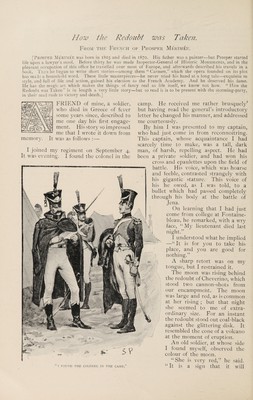
![From the Frkxch of Prosper Merimee. [Prosper MkRIMKE was born in 1803 and died in 1870. PI is father was a painter—but Prosper started life upon a lawyer’s stool. Before thirty he was made Inspector-General of Plistoric Monuments, and in the pleasant occupation of this office he travelled over most of Piurope, and afterwards described his travels in a book. Tnen he began to write short stories—among them “ Carmen,” which the opera founded on its plot has made a household word. These little masterpieces—he never tried his hand at a long tale—exquisite in style, and full of life and action, gained his election to the P'rench ^Academy, And he deserved his fame. Pie has the magic art which makes the things of fancy real as life itself, we know not how, “ How the Redoubt was Taken” is in length a very little story—but to read it is to be present with the storming-party, in their mad rush to victory and death,] FRIEND of mine, a soldier, who died in Greece of fever some years since, described to me one day his first engage¬ ment, His story so impressed me that I tvrote it down from memory. It was as follows :—• I joined my regiment on September 4, It was evening. I found the colonel in the I FOUND THE COLONEL IN THE CAM?/ camp. He received me rather brusquely’ but having read the general’s introductory letter he changed his manner, and addressed me courteously. By him I was presented to my captain, who had just come in from reconnoitring. This captain, whose acquaintance I had scarcely time to make, was a tall, dark man, of harsh, repelling aspect. He had been a private soldier, and had won his cross and epaulettes upon the field of battle. His voice, which was hoarse and feeble, contrasted strangely with his gigantic stature. This voice of his he owed, as I was told, to a bullet wTich had passed completely through his body at the battle of Jena. On learning that I had just ? come from college at Fontaine- I bleau, he remarked, vdth a wry I face, “ My lieutenant died last night.” I understood wTat he implied —“ It is for you to take his place, and you are good for nothing,” A sharp retort ^vas on my tongue, but I restrained it. The moon ’was rising behind the redoubt of Cheverino, which stood Uvo cannon-shots from our encampment. The moon Avas large and red, as is common at her rising ; but that night she seemed to me of extra¬ ordinary size. For an instant the redoubt stood out coal-black against the glittering disk. It resembled the cone of a volcano at the moment of eruption. An old soldier, at whose side I found myself, observed the colour of the moon. “She is very red,” he said. “ It is a sign that it will](https://iiif.wellcomecollection.org/image/b30479460_0084.jp2/full/800%2C/0/default.jpg)