Sir Thomas Browne's Religio medici : Letter to a friend, &c. and Christian morals / edited by W.A. Greenhill.
- Thomas Browne
- Date:
- 1901
Licence: In copyright
Credit: Sir Thomas Browne's Religio medici : Letter to a friend, &c. and Christian morals / edited by W.A. Greenhill. Source: Wellcome Collection.
31/464
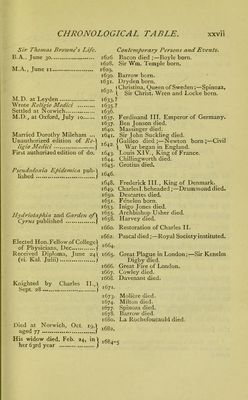
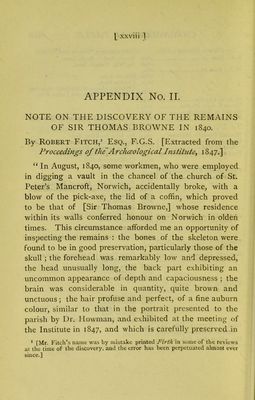
![added here is that in 1840, about five years after the publication of Wilkin’s edition, his coffin was found accidentally in the chancel of the church of St. Peter’s Mancroft, in Norwich, with a curious inscription, written probably by his son Edward,1 which gave rise to an antiquarian discussion that would have amused both Father and Son. The curious way in which some quaint passages in his writings were illustrated in his own person, is too remarkable to be left unnoticed. He says, “When there are no less than three hundred sixty-five days to determine their lives in every year, .... that [any persons] should wind up upon the day of their nativity, is indeed a remarkable coincidence.” 2 He was himself an instance of this “remarkable coinci- dence,” for he died on his seventy-seventh birthday. Again, he calls it a “ tragical abomination ” for us “ to be knaved out of our graves, to have our skulls made drinking-bowls . . , . to delight and sport our enemies.” 3 Would he have been much better satis- fied if he could have foreseen that his skull, after being “knaved out of his grave, would be kept under a glass case in the Museum at the Norwich Hospital? * Some notice of this discovery may be found in the Quart. Rev. 1851, vol. lxxxix. p. 391 ; Edinb. Rev. 1879, vol. cl. p. 56 ; and in the Appendix to this Preface, No. II. a Letter to a Friend, § 8, p. 133. J Urn Burial, ch. 3, p. 30, ed. Bohn, where *' knaved ” is changed into “gnawed. To kyiave is to thieve, cheat, steal.](https://iiif.wellcomecollection.org/image/b24879551_0033.jp2/full/800%2C/0/default.jpg)